Artistic approach
Sheila Hicks is the artist entrusted with the fourth of the Centre-Val de Loire Region’s three-yearly commissions for the Domaine de Chaumont-sur-Loire (2017-2019).
In a château which, apart from its gardens, accommodates an outstanding collection of antique tapestries, works and gardens renowned worldwide, and after Gabriel Orozco’s "Fleurs fantômes" ("Phantom flowers”), inspired by the wallpapers in Princess de Broglie’s guestrooms on exhibition alongside Sarkis’ stained-glass windows, what could be more natural than inviting an artist who has perfected an art that makes use of all the possibilities inherent in the beauties of nature?
Sheila Hicks uses thread, fibres and their colours with extraordinary virtuosity, in the same way that painters uses their pigments.
In her eyes, every creation is a journey, an exploration she undertakes with wonderful coloured volumes and monumental ropes woven in a breathtaking array of natural and synthetic fibres, which she always takes along with her and with which she invents her infinitely poetic universes.
Monumental installations, delicate collages and weavings of wool and linen are all part of the same science of colour developed by a towering artist who has perfect command of the many textile practices she has encountered in some of the remotest corners of the world during her countless voyages of discovery.
CREATING A WORK OUT OF A LINE
"For me, Chaumont-sur-Loire is a place apart, a refuge, a space where I have true freedom to create.
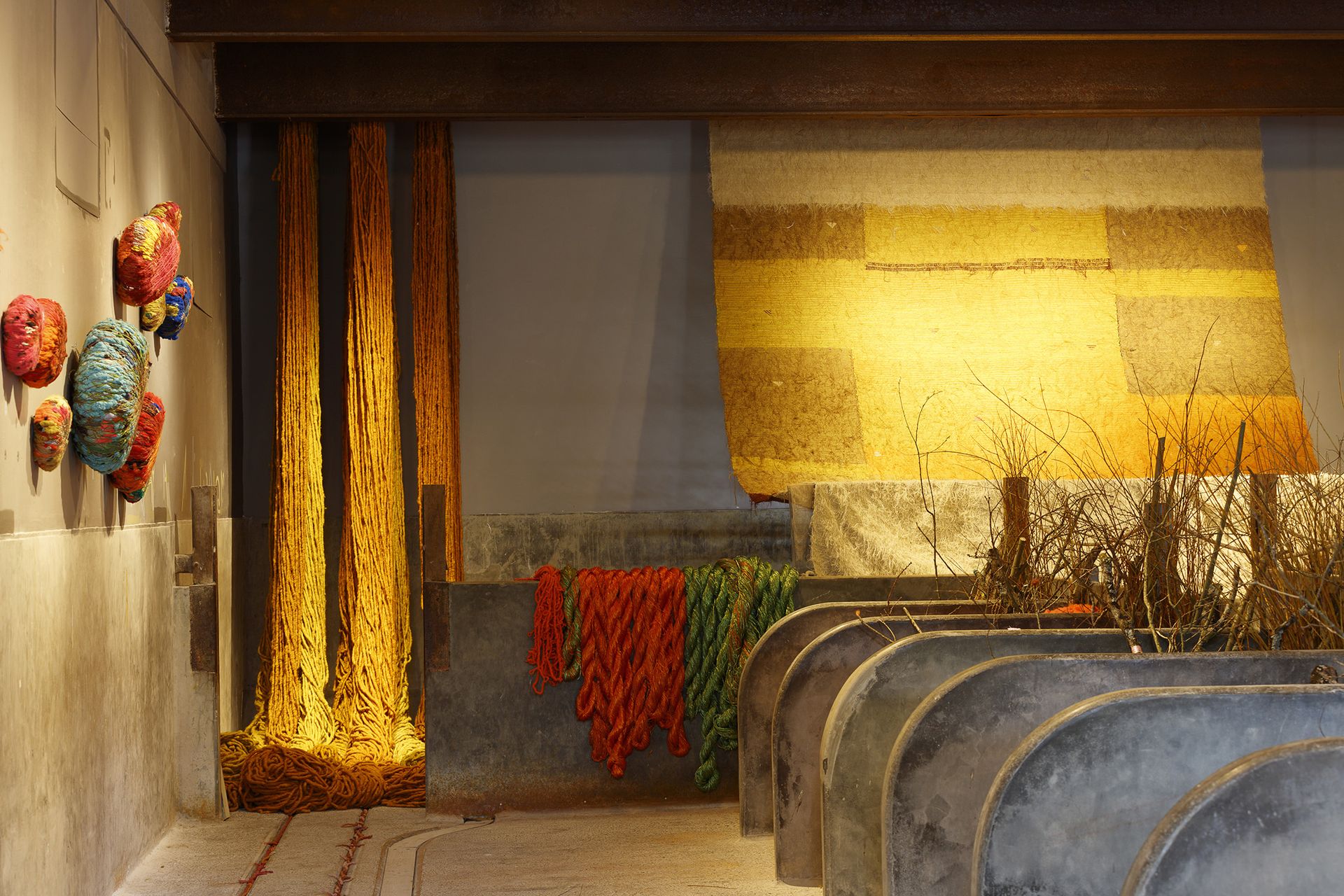
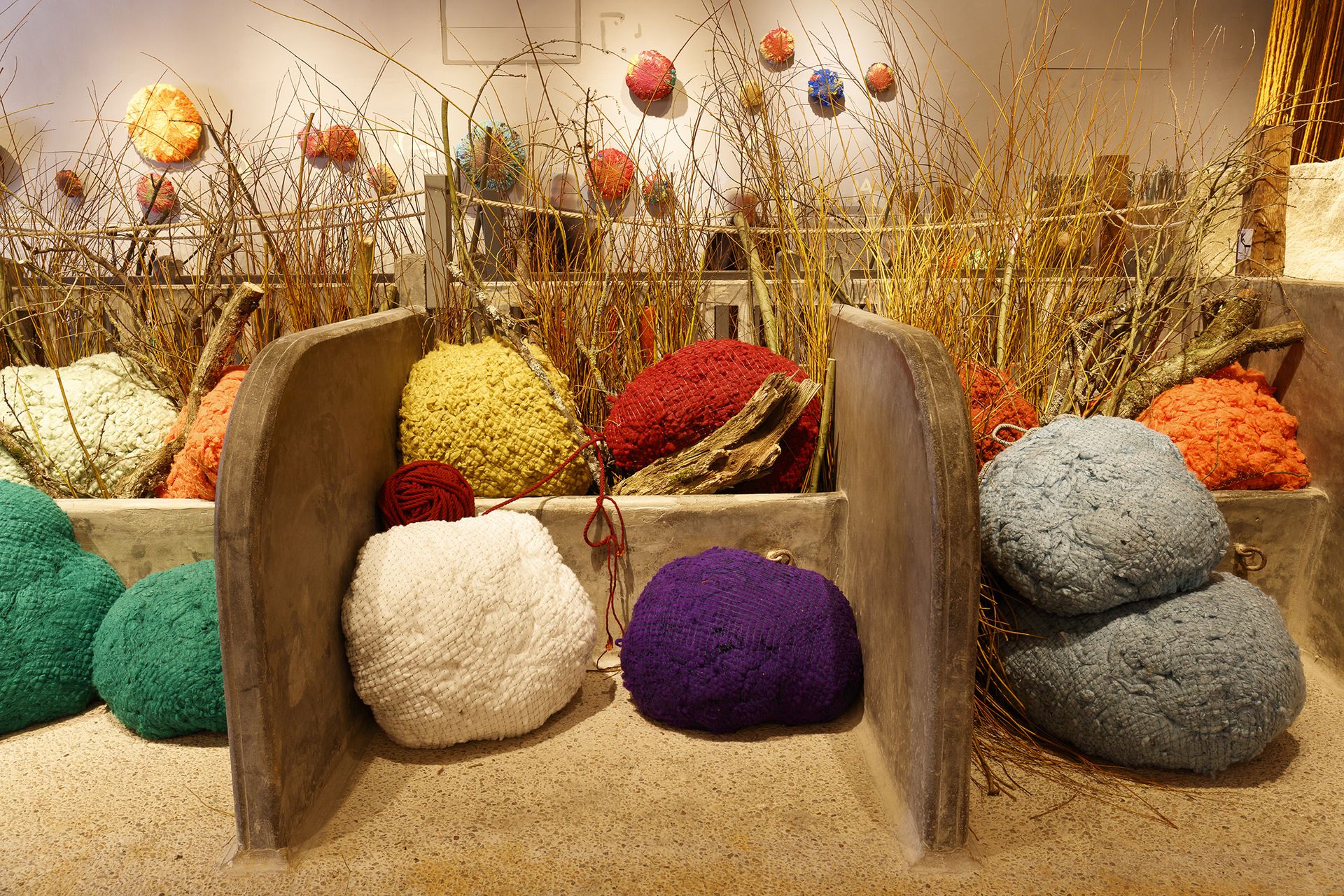
The Fenil Gallery is an altogether unusual space whose architecture inspired me immediately. I also had the idea of using the mangers of this stable, from which calves fed in the days of Princess de Broglie, as receptacles for the accumulated balls of natural pigments, they too nourishing and serving as a base for the works hanging on the walls and within the area.
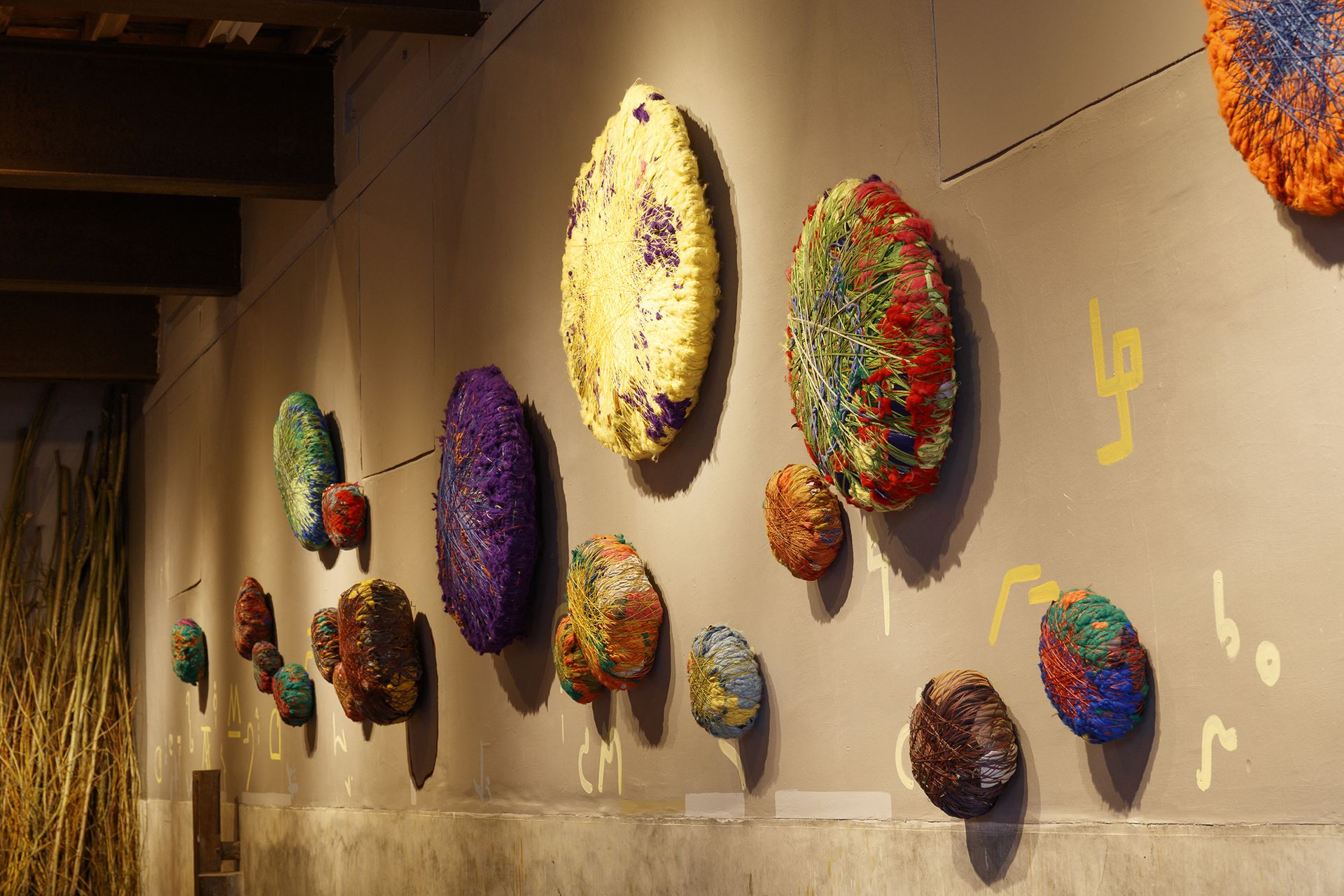
The “satellites” hanging from the walls are like constellations of an interplanetary, interstellar garden.
The gallery’s concrete, old, grey and weathered by time, enables fruitful dialogue to be engaged with the fibres’ infinite colours.
On this Estate, where nature plays such a major role, I’ve used natural components for the first time – branches, for example, twigs and brushwood that intermingle with my ropes and pigments. I wanted to combine nature with the fibres and threads that are the staples of my work.
These components are set off by a central panel handwoven in Guatemala, a rich landscape made up of sumptuous primary colours and a yellow and gold flow, a celestial waterfall that brings us peace.
The work is entitled “GLOSSOLALIA”, this being the term for speaking in some mysterious incomprehensible language, like the signs that run along the gallery walls: Sanskrit, shorthand and so on… it’s up to each of us to recognise these real or invented languages, which are perhaps the language of angels.
Although you will find a number of features here that recur in my visual vocabulary, the work I’ve created at Chaumont-sur-Loire is unique.
What has always inspired me is refusal of repetition, the wish never to do again what I’ve already done. I want to be in continual invention and create something that has never existed before.
One of the keys to this constant thirst for renewal is to be found in the contradictory worlds of my childhood: that of the general store my maternal grandfather owned in town, whose multitude of contents always left me spoiled for choice, and that of my paternal grandmother Ida’s farm, a simpler place where you always had to make something out of nothing. These contrasting influences are one of the keys to my endless obsession with creation.
I like creating colours not to be found in nature. I’m in constant invention of new discoveries, like those coloured satellites on the walls, providing shocks and surprises.
In my eyes, all colours can go together. It depends on how many different layers of material there are, on how much light there is and on the density of the shadows of the rays of colour, of the silk or linen threads, intertwined and stretched taut, that provide the works with their presence.
From colour there emanates an energy, a spiritual force, a feeling of peace.
There can be no doubt that colours generate pure emotions and speak directly to the soul.” Sheila Hicks.
BIOGRAPHICAL NOTES
Sheila HICKS
USA
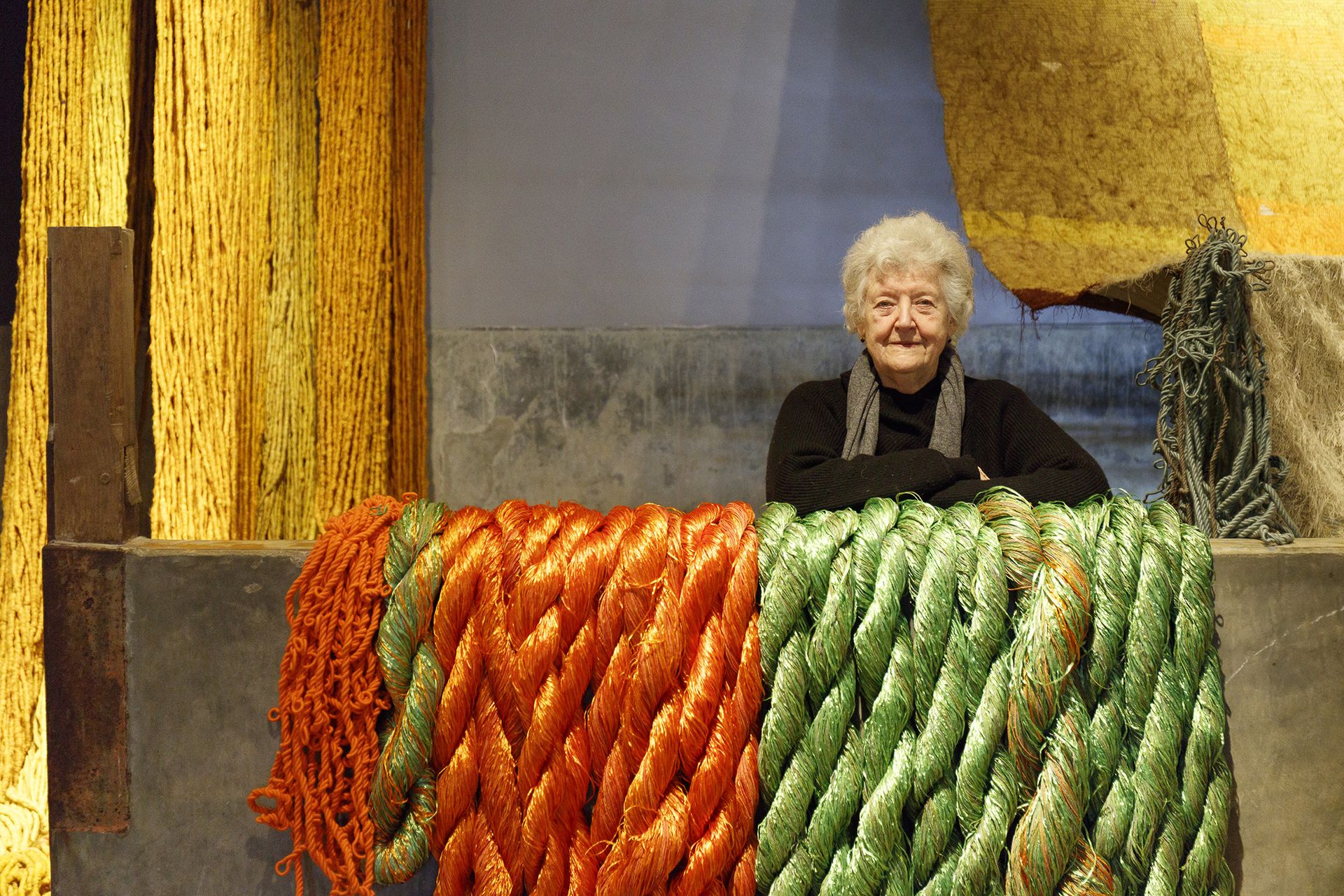
In 1964, Sheila Hicks decided to move to Paris to live and set up her studio there. Born in Nebraska in 1934, she studied under Josef Albers and George Kubler at the Yale School of Art and Architecture, travelled extensively in South America and spent five years in Mexico. She has made her Paris studio the ever-active centre of an open-ended body of work, where thread and textiles give shape to a tactile, sensitive and immediate “international language”. For her, creation is a process in constant motion, nourished by the encounters and dialogue that mark it, the cultures and techniques she has studied, and the architectural works that host her installations.
Since the 1960s, Sheila Hicks has focused on work that finds its centre of gravity at the crossroads of applied arts and contemporary art. In 2016, she took part in such events as the 20th Sydney Biennale, the Glasgow International Festival, and Weaving & We – the 2nd Hangzhou Triennial of Fibre Art. The same year, the Joslyn Art Museum in Omaha (Nebraska) devoted a retrospective to her entitled “Sheila Hicks: Material Voices”. In France, she exhibited at the Palais de Tokyo (Paris) and the Consortium (Dijon) in 2014; and abroad, at the 30th São Paulo Biennale in 2012, the Whitney Biennale (New York) in 2014 and the Hayward Gallery (London) in 2015.
She will be a guest at the 2017 Venice Biennale and at the Centre Pompidou in 2018.