Artistic approach
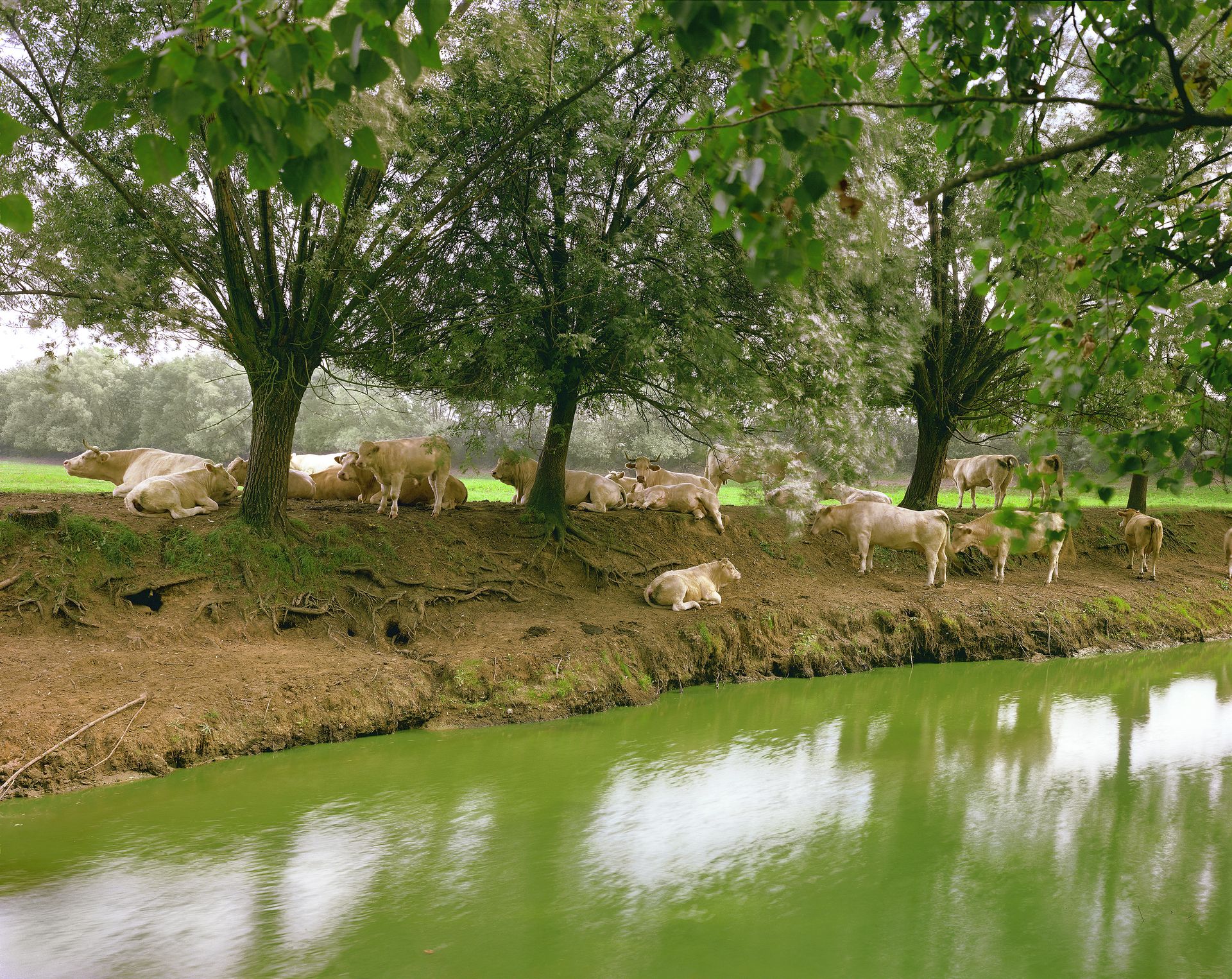
The La ferme du Garet series (1984), which are some of the photographs exhibited at the Domain of Chaumont-sur-Loire, occupy a unique, intimate and deeply-rooted place in the work of Raymond Depardon. Today, this testimony to rural life is familiar to those who know the work. After the publication of this series as a collection in 1995 (Editions Carré, republished by Actes Sud), the trilogy Profils paysans (2001-2008), filmed together with his wife Claudine Nougaret, was published and includes La terre des paysans (Le Seuil, 2008), Paysans (Points, 2009) and more recently Rural (Cartier Foundation for Contemporary Art, 2020). In 1984, when Depardon returned, lens in hand, to his childhood farm in Villefranche-sur-Saône, he was in the process of bridging the chasm between his career and his origins, thanks to a commission - the legendary Mission photographique awarded by DATAR (Land Development and Regional Action Delegation).
As commemorated in the exhibition Paysages français. Une aventure photographique. 1984-2017 at the BnF in 2017, twenty-nine photographers were commissioned to “Depict the French landscape of the 1980s”. The Mission followed in the footsteps of iconic projects in the history of photography such as the 1851 Missions Héliographiques commissioned by the Monuments Historiques or the Farm Security Administration project (1935-1942), which built up a portrait of America during the Great Depression. There was also the New Topographics exhibition shown in 1975 in the United States, which proved to be the turning point which contributed to revisiting the image of the countryside in America by attributing more importance to the everyday and ordinary.
Raphaële Bertho, author of La Mission photographique de la DATAR, Un laboratoire du paysage contemporain (La Documentation française, 2013) and curator with Héloïse Conesa of the BnF exhibition, highlights photography’s dual importance in the field of art and public policy. On the one hand, “The beginning of the 1980s was a turning point for photography as it became incorporated into contemporary art institutions. […] By approaching photographers who were considered artists, and by giving the resulting photographs the status of works of art, DATAR’s photographic Mission actively participated in this process of institutional recognition.” On the other hand, “It was part of a political questioning about the countryside which was expressed in the early 1980s around the notion of landscape”. “Giving photographers the task of rendering intelligible a visually palpable experience while revisiting the perception of the countryside and explicitly asking them to recreate a culture of landscape in France.”
The famous reporter was given the opportunity by the DATAR commission to return to his parents’ farm. This personal journey became inextricably entwined with a project of public interest. It is a portrait of his childhood home following the death of his father, whose absence deepens the images. It is a portrait of “A place which can be seen all over France”, and which has witnessed all the changes experienced in the country during the ‘Trente Glorieuses’. “When you are on the A6 motorway, [...] in front of a big shopping area, you can see a group of houses surrounded by acacias for a few seconds. This is the old quarter of Le Garet”, writes Depardon (La Ferme du Garet, 1995). On the one hand, it is a secret garden revealed in confidence - the journal of a return to the land of his birth which weaves together the portrait of a place with the story of a vocation. On the other hand, it is a sociological, geographical and political document, in which Depardon undertakes, with regard to his sponsors, “To show what you developers have done to my parents’ farm”. He asks himself “Yesterday, it was in the countryside, today it is on the outskirts of the town. And tomorrow?”
About forty years separate us from these images, which is about the same period which separates these images from the Le Garet which Depardon remembers as a child. In both cases, there are changes and elements which remain constant. La Ferme du Garet is neither a nostalgic search for a lost paradise, nor a portrait of a devastated land. It has all the depth of a work of literature. There are few cues in these images, only scattered traces like the words of a poem. Your gaze, deprived of distraction, lingers on the materials - the shine of the oilcloth, the coolness of the tiles, the caress of the crocheted curtains, the warmth of the sun in the corner of the courtyard and the fleeting presence of a shadow (his mother). Your gaze becomes tactile. “I’ve a feeling that I didn’t look. I found it hard to look,” confesses Depardon. “The camera made me look.” The apparent emptiness can in turn teach us how to look. Depardon suggests how - with imagination. “I try to capture the reality before me. Reality is often not very interesting. So, I turn to dreaming!” We can now understand the ever-renewed interest aroused by this anti-dramatic series which we think we know and which can then be rediscovered again through new hangings and original readings, such as Jacques Rancière’s La Chambre (Atelier EXB) in 2020.
La Ferme du Garet tells its tale in Chaumont differently to elsewhere. Each time a small piece of the veil is lifted, and what it all means is never exhausted. The images invite you to observe their silence. Let’s soak it up.
BIOGRAPHICAL NOTES

Raymond Depardon, the youngest member of a farming family, was born in 1942 in Villefranche-sur-Saône. He took his first photos using his elder brother’s camera. After moving to Paris, he joined the Dalmas agency in 1959, where he worked on numerous reports, including the one that earned him a name in the Sahara. In 1966, he co-founded the Gamma agency. He filmed his first short film in tribute to Ian Palach in Prague in 1969. In 1974, as managing director of Gamma, he made his first feature film which followed the campaign of Valéry Giscard d'Estaing. In the 1970s, he travelled through Chad on the trail of the hostage, Françoise Claustre. In 1978, he joined Magnum and learnt about “Photographing people in the street”. Notes was published in 1979, creating a new relationship between words and images. This became a common thread in the second part of his career, when the photojournalist became a documentary filmmaker. In 1987, Depardon married Claudine Nougaret, the first female chief sound operator in France. From then on, they created together, finding “A good balance between listening and looking”. In the 2000s, he exhibited at the Cartier Foundation, Maison Européenne de la Photographie, the Bibliothèque nationale de France, the Grand Palais and Mucem. Les Rencontres d’Arles asked him to become artistic director in 2006. He founded BAL, which opened in 2010. In 2012, he shot the official portrait of the French President of the Republic, François Hollande. Meanwhile, his work also continued to grow and develop. As a recorder in film and in photography of both rural life and the desert, country folk and nomads, wide-open areas and enclosed spaces, Depardon remains faithful to his fundamental principles of meeting and listening.
Raymond Depardon is represented by Galerie RX in Paris.