Artistic approach
FÛTS, 2024
“A long, curved line crosses the wide-open space in the grounds. It is a sort of anonymous, enigmatic sign in this place brimming with history and art. What does it mean? Maybe it is a reference to the fleeting nature of our passage, of the restraint that an impressive place dictates to us, quite simply my taste for discretion. It’s about taking over a landscape without violence, without any inappropriate statements. This long line stretched out across the grass is made up of 5 interlocked, slightly conical-shaped elements, polygon at one end and circular at the other. It is a simple design, representing a complex form. These nested items are all cut with a hot wire from the same block of polystyrene, before being taken to a foundry where the fragile shapes were transformed into hollow iron structures. The quivering hand that held the wire and the waves of the alternating current create grooves on the material that resemble the veins of a tree. Fûts suggests the living aspect of the tree, the awareness of the logs lined up to go to the sawmill, to be transformed by the hand of man. My sculptures are abstract in essence and often suggest something physical, living, that invites the viewer into contact, to touch, stroke, to bend down, sit down. In the Historic Grounds, this warm, dark form will blend into the gentle relief of the meadow, creating a dialogue with the other collection of cast iron structures, Chaos, on the Loire hillside.”
COURONNE d'arbre, 2020
“Couronne d’arbre takes the form of a meshed ensemble that wraps around each trunk. The shapes are at the level of the first branches, and the nature of their entanglement remains enigmatic – are they rings, nests or thinly-woven cocoons that filter the light and allow the tree trunks to be seen through them? At first glance, their strange fashion of embracing the trunk cannot be seen, but when you look again, their intriguing shape evokes musings on the nature of weightlessness. The presence of the sculptor’s hand and the ring motif symbolises a kind of union between man and trees, as well as the same sensuality that pervades the Estate. These meshes are made from fig branches, a tree with erotic and Dionysian connotations, to evoke the wild and untamed forces of the forest. Each branch is first cast in bronze. The segments are then assembled and welded together. It is then a matter of improvising a veritable drawing in space. This is more than a work that glorifies the shapes of nature; it is a geometry, and a structured assembly. The bronze has a verdigris patina brought out by red and yellow ochre to give a colour reminiscent of lichen and that will one day become its natural patina. This reinforces the work's mimetic and almost hidden character.” Vincent Barré
CHAOS, 2014
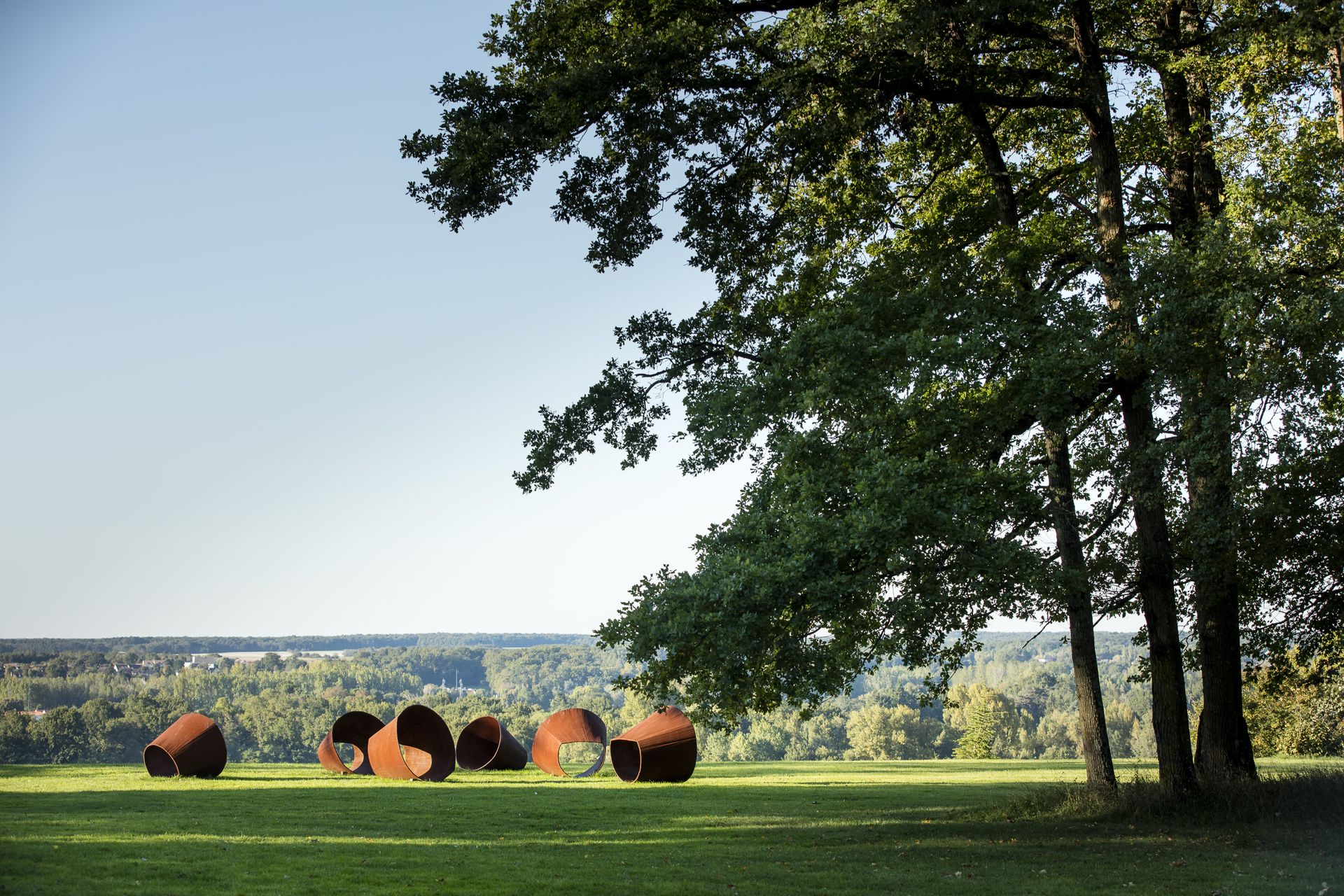
“It was my discovery of the Pietà (altarpiece) by Jean Fouquet – one of the finest Renaissance paintings – in Nouans-les-Fontaines, not far from Chaumont-sur-Loire, that got me musing once again on timeless things: The majestic sweeps of colour on the clothes which structure the large wooden panel, the interplay of impassive, internalised faces, the tight composition around a broken form, the chastity of a nude ... And in the bottom left-hand corner, lying on the ground like the three nails, a crown of solid twisted branches. The emotions stirred up before this painting inspired me to give them substance through sculpture, for a presentation of two works in the resolutely contemporary setting of Chaumont." Vincent Barré
In the Historic Grounds, on the hillside, Vincent Barré has laid out a cast iron sculpture in 6 parts, through which we can see the surrounding landscape, ever changing, always fragmented and framed by the rings when we move or rest a moment between the blocks.
BIOGRAPHICAL NOTES
Vincent BARRÉ
FRANCE

Vincent Barré is a multifaceted artist, an architect, sculptor and director all rolled into one. He likes to consider his work as a part of the history of thought and creation, a reflection of eras and civilisations of the past. Born in 1948, he studied architecture in France and then in the United States under architect Louis Kahn. During his studies, he drew a lot and travelled around Europe, America and Asia. After working as an architect for ten years, he decided in 1982 to devote himself exclusively to sculpture.
His work is represented by the Corkin Gallery in Toronto (Canada).