Artistic approach
Sam Szafran is an altogether atypical artist, a painter completely without ties, unclassifiable, extraordinary, outside any discernible movement. Possessed of rare sensibility and culture, he has succeeded in converting the many sufferings of a difficult life into a body of work of unique power and virtuosity.
He has produced close to 2,000 works, comprising 800 watercolours and 1,200 pastels of incredible chromatic richness, created with phenomenal dexterity by an artist who has stated that he has “enough to keep me drawing for 400 years”.
“His drawings are pretexts for a perfectly mastered abstract playfulness that animates the inanimate and gives the power of life to the inert”. Jean Clair
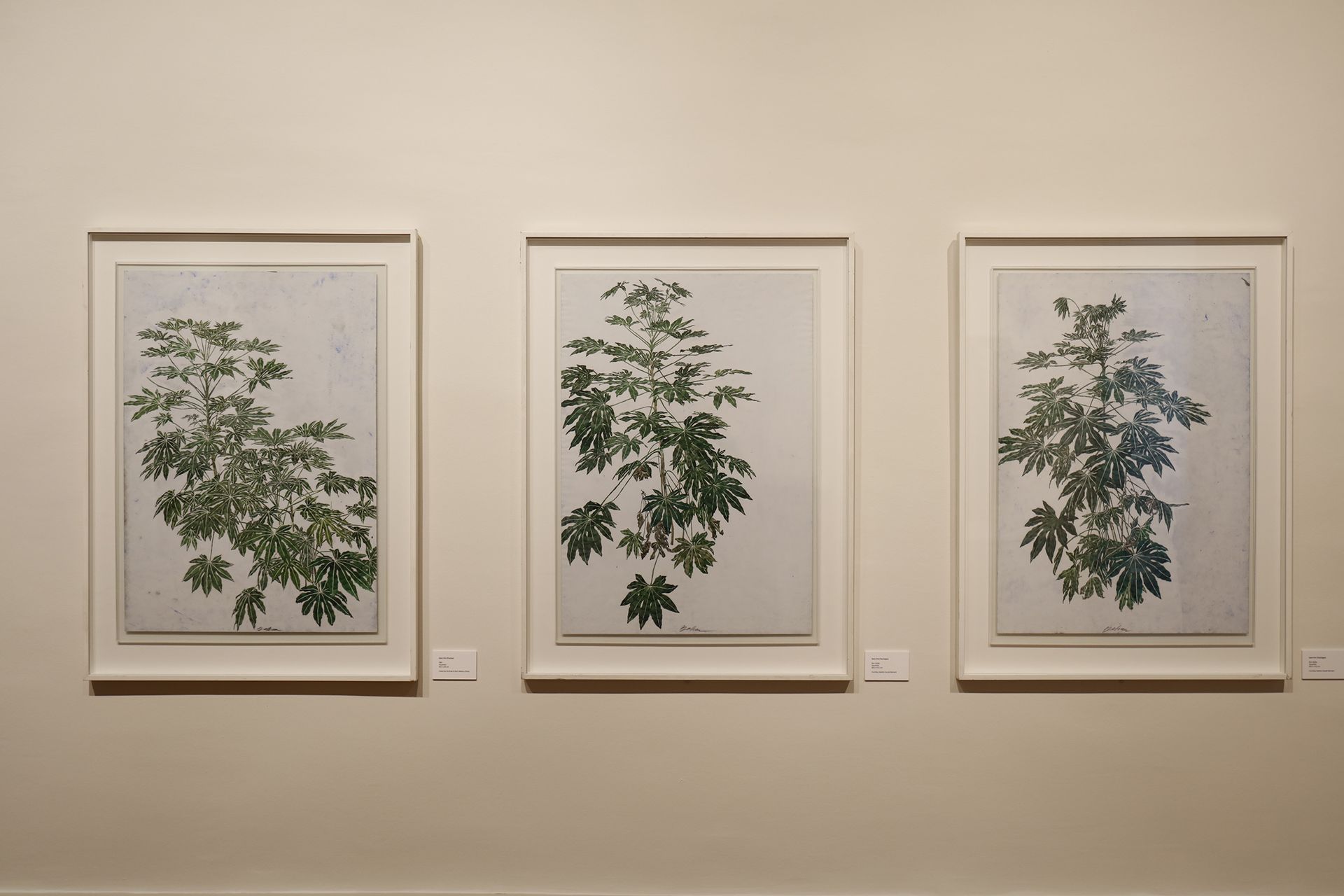
Three major themes run through his work in almost obsessive fashion: studio interiors, staircases and plants.
It is obviously his phantasmagorical foliages and arborescences that will be on display at Chaumont-sur-Loire, in an exhibition bringing together many of the artist’s masterpieces on loan from private collections.
With his inextricable jungles of philodendrons and hallucinatory cascades of finely worked Monstera leaves, Sam Szafran reinvents nature, concentrating it into extraordinary hanging gardens. The mysterious and vertiginous luxuriance of these inner landscapes harbours incredible poetic power.
"There’s always a sense of imbalance in what I do.”
"My perspective is closer to the Arab perspective, based on the eye’s oval shape rather than traditional geometric perspective, which is characterised by a horizon line and vanishing points”.
"Something else results from it, another ambience, another system, another way of seeing. An invention started over and over again.”
"I need chaos; my studio is chaotic, between layers of books, pastels lying around everywhere and piles of this, that and the other. In order to produce something, I need to start out from chaos”. Sam Szafran
BIOGRAPHICAL NOTES

1940–1944
During the war, Sam Szafran escapes the Vel d’Hiv Roundup, hiding out first of all at a farmhouse in Loiret. Imprisoned in Drancy, he is freed by the Americans and goes into hiding in Lot, taken in by some Spanish Republicans.
Académie de la Grande Chaumière, in Henri Goetz’s studio; makes the acquaintance of Jean Ipousteguy, Orlando Pelayo, Jacques Delahaye, Nicolas de Staël, Jean-Paul Riopelle, Joan Mitchell, Yves Klein, Jean Tinguely and many others; a series of makeshift studios.
“Choux” Period (during which he painted cabbages). The gift of a box of pastels marks a major turning-point in his work; from now on pastels become his preferred tools of trade.
Retrospective at the Gianadda Foundation, Martigny, where he exhibits his very large format works for the first time.
Sam Szafran is represented by the Claude Bernard Gallery.