Artistic approach
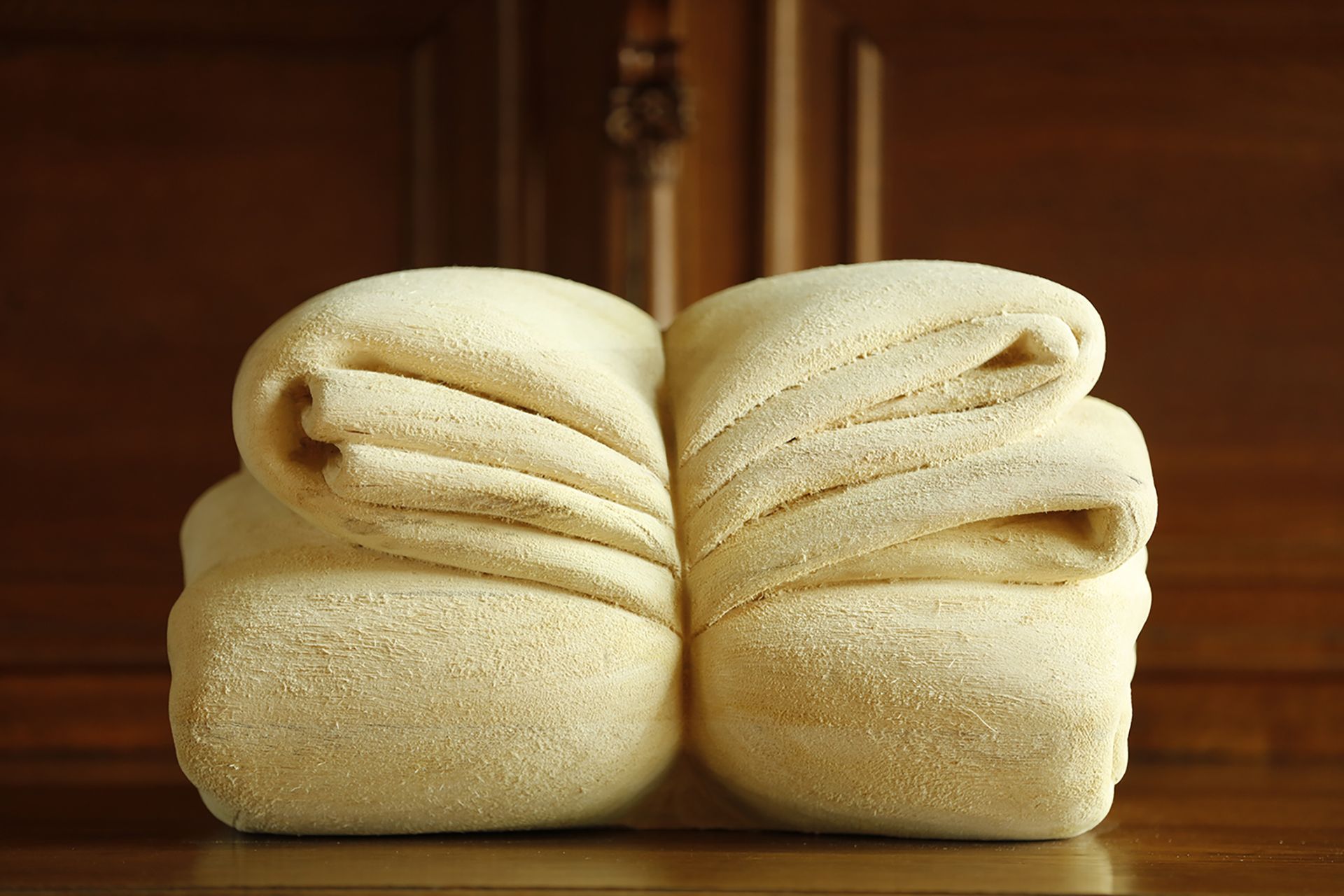
Christian Renonciat is a past master at the art of playing with appearances and surprising the eye. He “makes wood talk”, suggesting sponginess, fragility and softness with a hard material that he masters to perfection, combining amazing technical virtuosity with a deep-seated and highly sensitive conceptualisation of his work.
"TROUBLEMENT"
"Behind the neologism of the title (shall I be granted poetic license ?) is an imaginary matter. Perhaps I felt jaded by the delicate embroidery of my cardboard fragments, and simultaneously I was encouraged by my friends in architecture to expand my work to the monumental scale. I begin to think of a primitive material, a bit prehistoric, earthy and mineral, shreds of which would have passed down to us through the ages: an archeological material so to speak. Half wall, half mountain, its inspiration is drawn from cardboard, and the wounds (rips) reveal the corrugations beneath, belying the surface aspect that suggest the density of hardwood.
Tremor is a condensation : the troubled surface of the Earth in formation, like a metaphor for what any person feels faced with a fearful event : a troubling sensation that may be frightening or delectable, experienced in sensorial confusion.
Technically, I moved from the gouge to the chain saw, and whenever possible I have tried to keep the energy of the sweeping cuts, the freshly opened feel of the gashes.
The surfaces of these heavy panels are coloured, or given a patina of age : various shades of green and blue are more or less projected, with a few discreet splashes of bright red. The appearance of a surface worn smooth by time is a stark contrast to the pale warm hues of the cut poplar, which has a ripped appearance.
Indeed the corrugated structures are revealed through a wound-like opening, but that movement cuts across the ridge tops as if on the horizon of a landscape, so that the overall impression is peaceful." Christian Renonciat
"DOUCEURS"
"These sculptures are nothing less than a mirror held up to the subject, reflected in its most favourable light : surface, grain, warmth and tenderness in supple, fluid and suave matter. The name – signifying both sweet and soft and French – is indicative of the ambiguity that binds the corporeal to the material nature of things, described in its sweet/softness with the same words we would use for a person’s body : caress, breathe, embrace. No doubt we find the indelible trace of our earliest sensations, our body enveloped by the mother, at once caressing and caressed… the incarnation – the term is apt – of the plenitude of paradise lost. Perhaps we experience this primal well-being though transitional objects that are an extension of the security blanket we constantly carried as a child, objects that may be an item of clothing, a sheet, a comforter.
This type of sensation, labelled “erotic” since the advent of Freud, is not under tension nor suffused with desire ; nor does it exist in a temporal context, on the contrary. The sensation is a caress, without beginning or end. A caress much like that of a lake that bears you weightless; nothing else matters.
If the viewer receives some of this happy feeling, it is not because I have carved out its delicate path : I make my mark, the wood yields its own, and the viewer provides the entirety of the sensation, as a personal experience imprinted timelessly in the corporeal memory. Some things are “known” : consistency, texture, scent, but some things are not perceived by the senses. You remember and you recognise the blanket you are looking at because it is your own." Christian Renonciat
BIOGRAPHICAL NOTES
Christian RENONCIAT
FRANCE
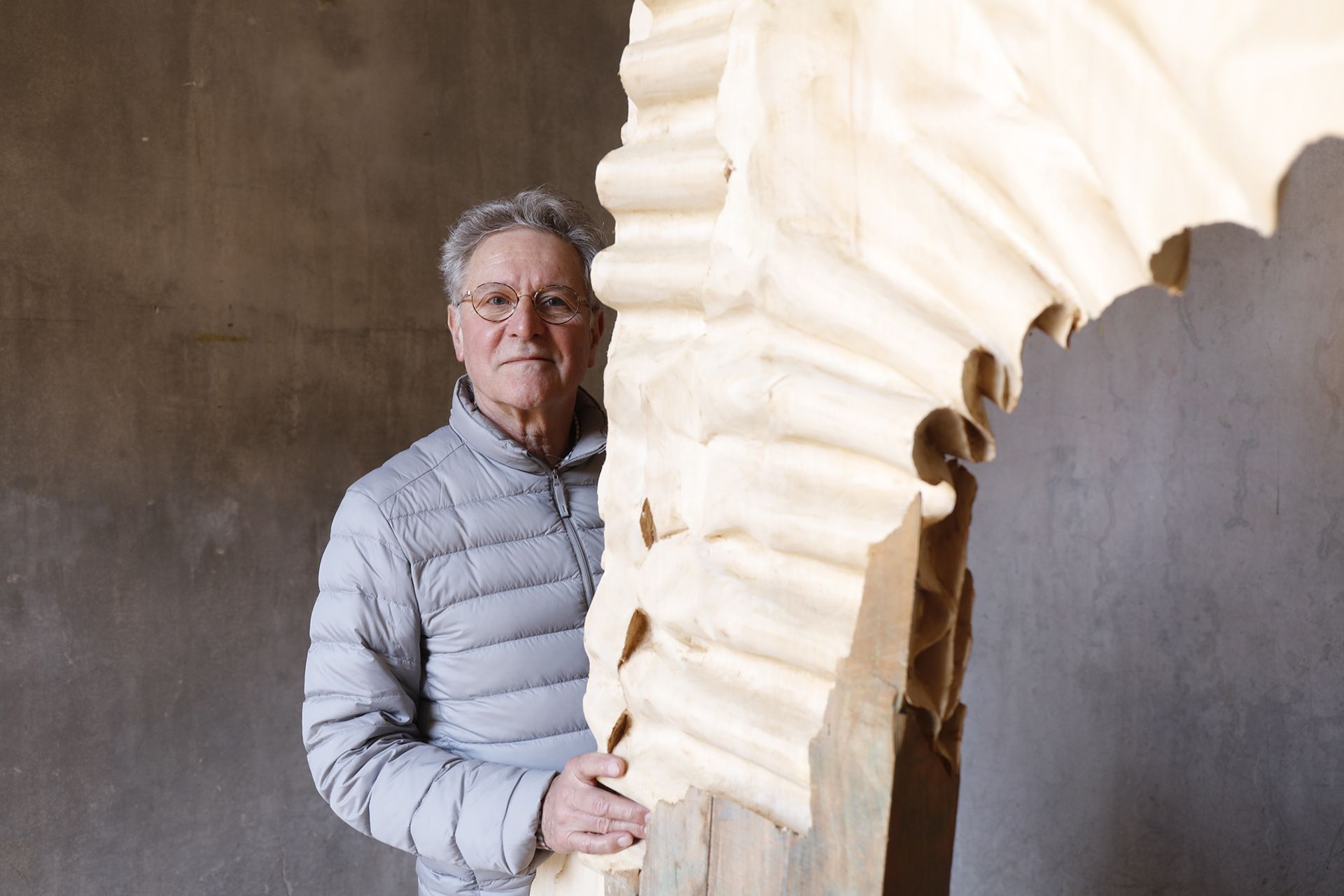
Born in Paris in 1947, Christian Renonciat graduated from the Sorbonne with a degree in philosophy.
In 1969, he joined an art studio in Antibes, where he spent six years learning all the techniques of working with wood. In 1975, he opened his own studio in Valbonne, where his first sculptures were created.
Upon his return to Paris, he mounted his first exhibition in 1978, held at the Alain Blondel Gallery. The passing years crystallised his interest in the substance of things as a subject, sculpted in wood via a range of representations running from the hyperrealistic to the hyper-abstract.
In 1984, he set out to explore a parallel path, monumental creations combining imagination and technique in a wide range of materials (including cast steel, bronze, aluminium and gardens), often with something of an imaginary archaeology about them.
These days, he is back to seeking out the substance of things in large-scale mural compositions of sculpted wood – tapestries of serge, plastic, wool, paper or cardboard.