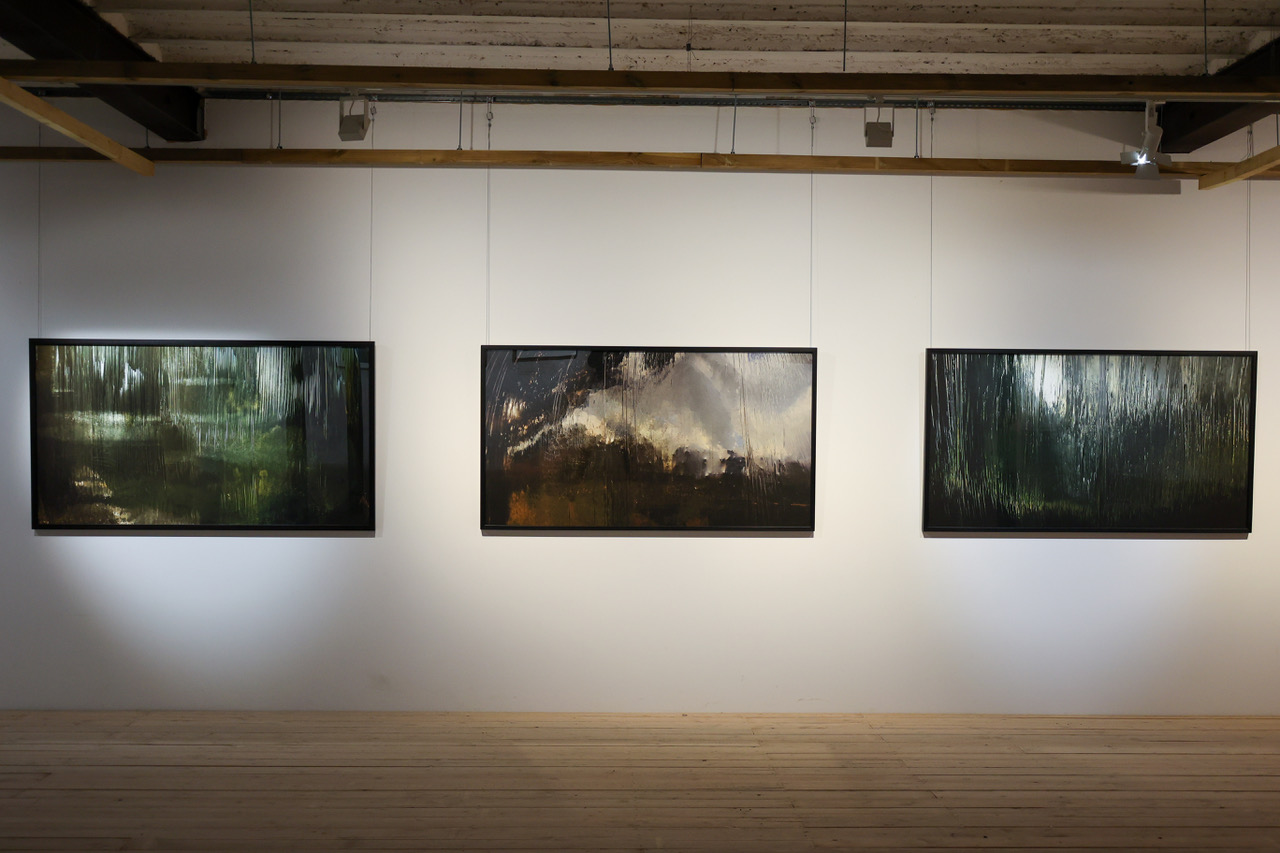
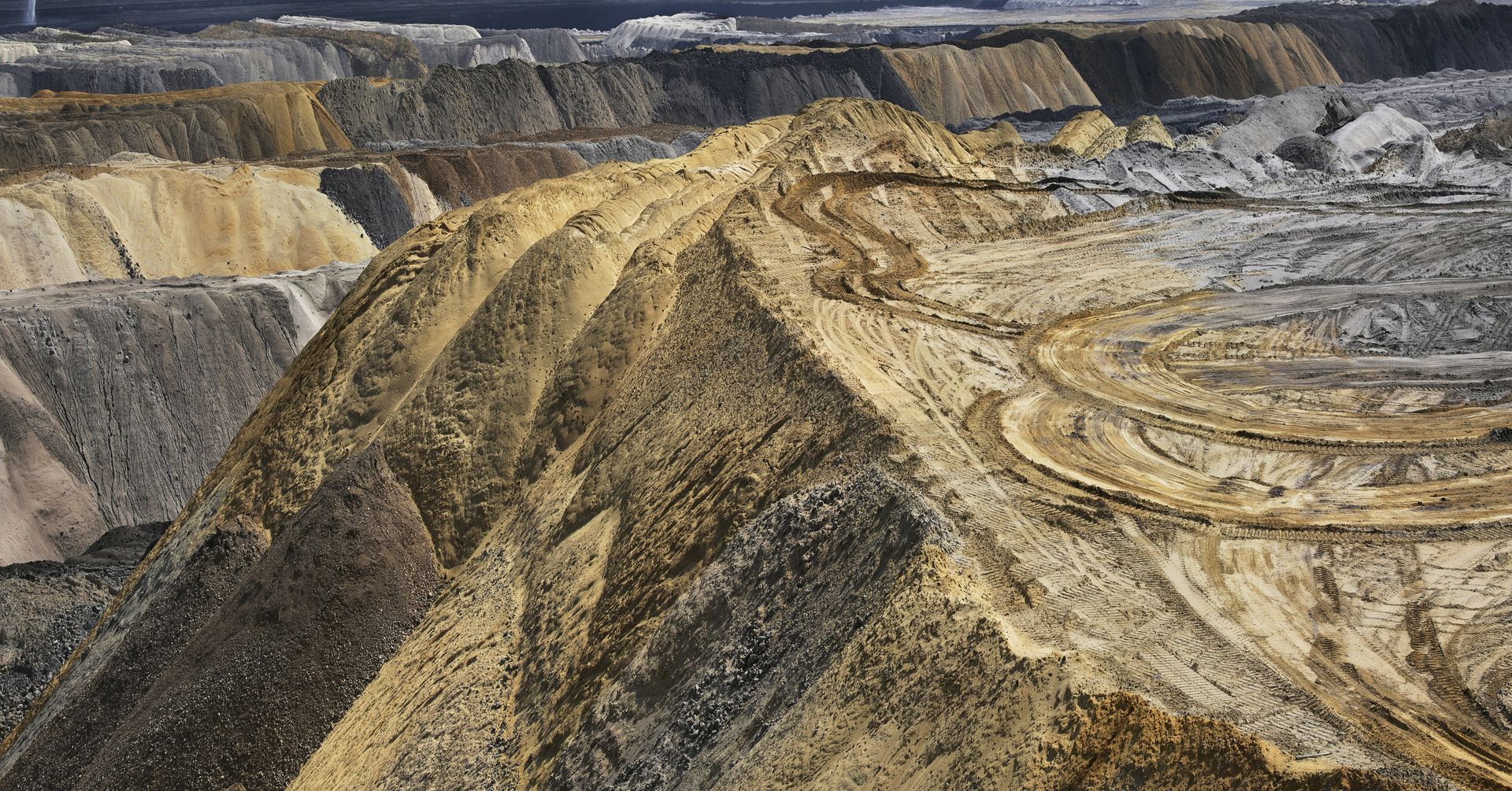
The five series exhibited by Tania Mouraud at the Domain of Chaumont-sur-Loire bring us face to face with the fragile beauty of the world.
Tania Mouraud’s photographs examine the changes which are taking place in the relationship between mankind and nature. Her photographs, which are shaped like paintings, are also where points of view are questioned. Where are we looking from? What are we seeing? How do we position ourselves in relation to the natural world to which we belong?
NOSTALGIA and ÉMERGENCES
The main focus of Nostalgia (2019) is a sense of vastness and of snow covering everything as far as the eye can see. Shot in the Nizhny Novgorod region, which is a major industrial hub for automotives, aeronautics and energy, the series reveals nothing of this frenetic activity, except for the vertical lines of pylons mixed in with the trees which can be picked out if you look very closely at the horizon. This is just like the spears (but human this time) bristling on the horizon in the final scene of Eisenstein's film Alexandre Nevski (1938), whose visual style “Made a strong impression” on the artist.
BORDERLAND
In Borderland (2007-2010), close-up views of tarpaulins covering bales of straw are transformed by the light into canvases reflecting a jumble of nature, sky and earth. These images bring to mind Monet’s Haystacks and the atmospheric landscapes of Constable and Turner. In terms of art, they occupy the border or borderland between abstract and figurative art.
BALAFRES
Balafres (2014) documents the irreversible impact on the landscape of lignite mining (a coal used for heating and electricity generation) in the vast open-cast mines in Inden, Garzweiler and Hambach in North Rhine-Westphalia, Germany. Although an artificial lake is planned to cover the Hambach mine when it closes in 2045, the title emphasises the irreversible violence inflicted on the site. At 293 metres below sea level, Hambach is one of the deepest open-cast mines, and its expansion eats away at the forest.
FILM NOIR
The unpublished Film noir series (2021), shot in Canada in 2011, shows swamps which evoke other cinematic memories (American ones) of chases in murky waters and the art of anguish - such as Hitchcock’s engulfing swamp in Psycho (1960), remembered as a crime scene. In this in-between place between land and water, where everything moves and is unsettling, a loss of control seems inevitable. The mire is all the more terrifying because it is coupled here with a pictorial beauty which fascinates the viewer, making them lose any point of reference.
These photographs place us in an environment which is difficult to decipher or to understand. The lines and their reflections weave an interlocked web which invites us to just let go, to contemplate only what we can understand with some effort and a certain detachment, and to temporarily come to a halt in our daily rush.
DESOLATION ROW
In Desolation Row (2018), fields of haystacks are depicted, creating high, blackened towers reaching to the sky and leaning so far over that you expect to see them “Fall with a funereal rumble”, as described in the Chant d’automne (Baudelaire, Les Fleurs du Mal, 1857).
The artist’s lens is asking “What is left of an activity when it has been pushed to excess. A material that is no longer providing food, but rotting and generating gas?” The dual theme of ruin and decay, in a similar way to a memento mori, becomes an invitation not to look away from what is disturbing. For the artist, “Being a citizen means living with your eyes open to the world” and becoming a witness. From the desolation may then arise a revelation in the etymological sense of Apocalypse to which Desolation Row refers. However, this is not a universal epiphany but more an awareness of our limits - yet another meaning of border.
BIOGRAPHICAL NOTES
Tania MOURAUD
FRANCE
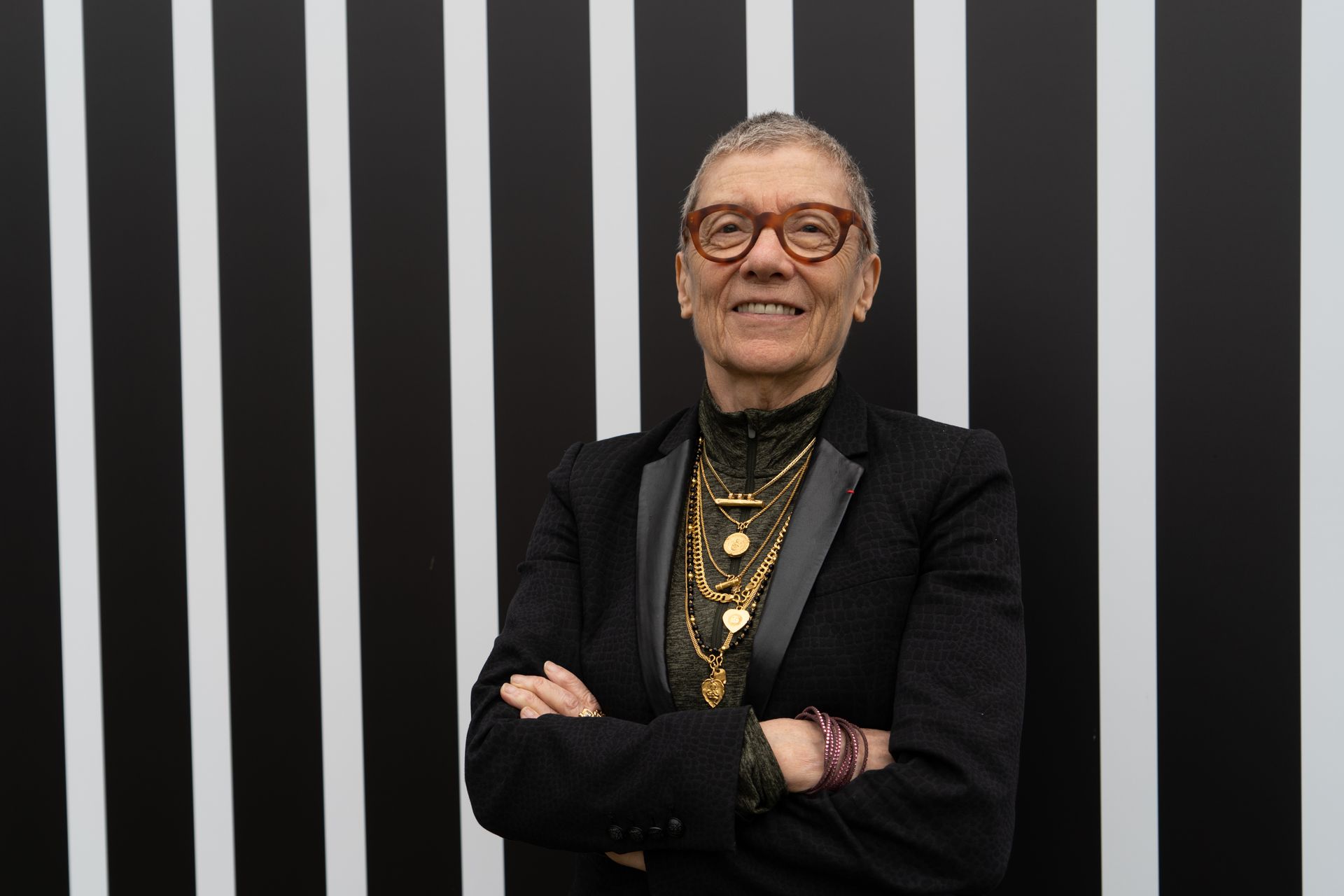
Tania Mouraud was born in 1942 to parents who fought in the Resistance. She is a self-taught creative artist. She learnt about art and history during her frequent visits to the Louvre, as well as through osmosis and friendships with the avant-garde set in Düsseldorf.
In 1968, she made a clean slate of all her painting work by burning all her pieces in the courtyard at Villejuif hospital. Her personal work, starting with Initiation Rooms (thirteen meditation rooms) was born from this freeing act. In 1977, City Performance n°1, a collection of 54 NI’s displayed in the place of advertisements on billboards in Paris, was created which denounced consumerism and the saturation of speech with its demands.
From 1988 onwards, this work involving words in urban spaces developed into the Wall Paintings - phrases stretched out on walls and requiring effort to decipher and read them. The video Sightseeing (2002) heralded a new creative chapter with a focus on movement and sound, while at the same time emphasising the relationship with history. Renowned for being intellectual and conceptual, her work asserts her blazing sensitivity to the world in its more recent forms. Between the two extremes of wonder and horror, embodied in a sudden, intense way in the videos Ad Infinitum (2009) (immersion in an ocean inhabited by whales) and Ad Nauseam (2014) (the destruction of books on an industrial scale), Mouraud demonstrates her key driving force. “What keeps my work alive is ethics. The formats vary, but the substance is always the same. That is my core mentality.”
Tania Mouraud is represented by Galerie Ceysson & Bénétière in Paris and by Galerie Claire Gastaud, in Clermont-Ferrand.