Artistic approach
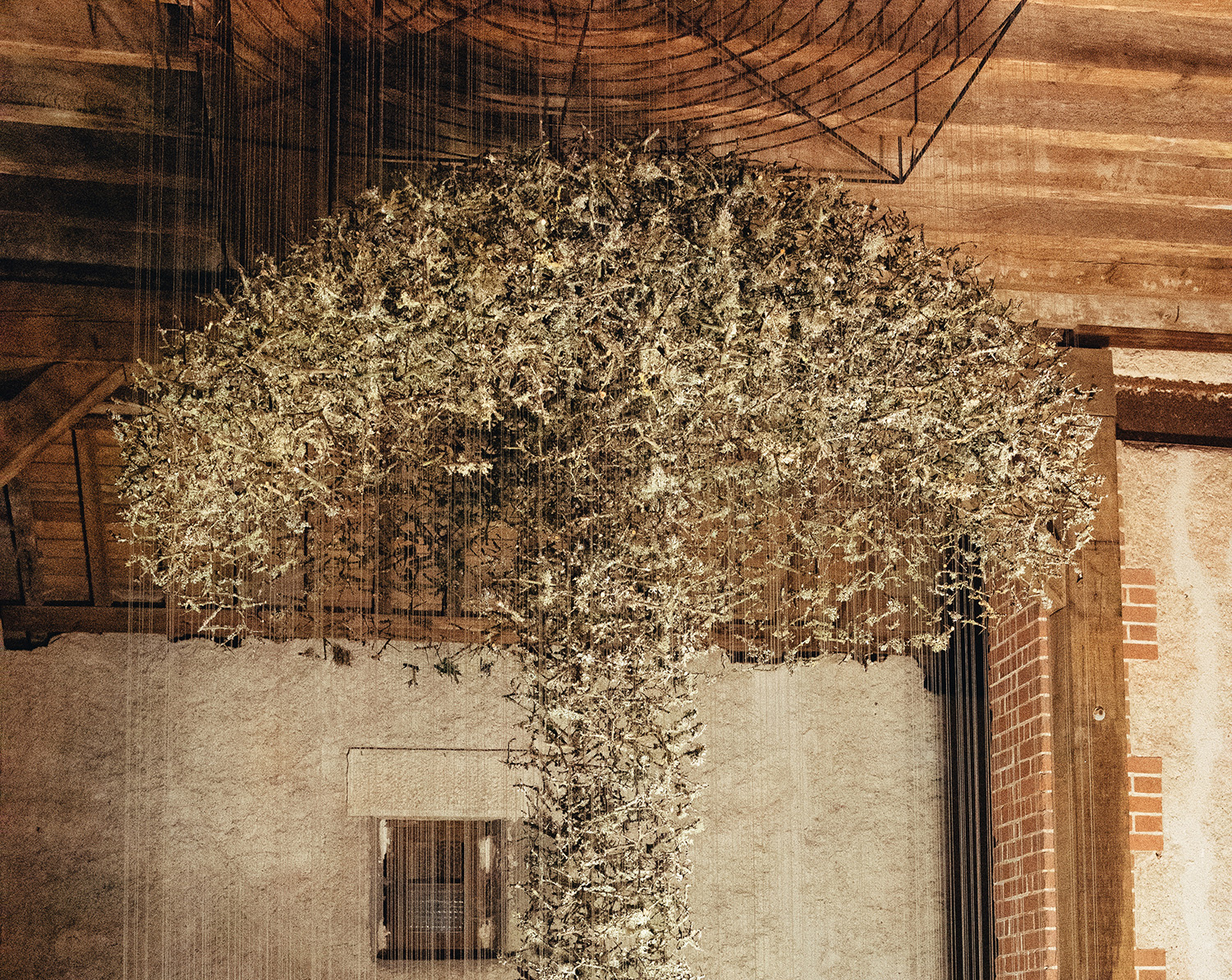
"The piece is in the shape of an amanita, Amanita Virosa, or Destroying Angel. It is one of the most deadly toadstools.
Fungi can feed, kill, cure or alter the mind. They are the most widespread organism on the earth, and without them, life would cease to exist. They decompose dead matter on the ground, where new life will then grow. Therefore they contribute to the cycle of life, death and regeneration. Thanks to fungi, our world is constantly transformed and renewed. Trees are interconnected through their roots, and communicate via their mycelium and hyphae. Fungi act as the link between species. They don’t use light for photosynthesis as plants do, but are more closely related to animals as they have to search for food and digest it by excreting acids and by exchanging these nutrients for the sugar from plants and trees. A forest is just as well developed underground as it is on the surface.
Fungi come from mycelium, which itself is made of hyphae, a network of filaments that stretches across the forest and can be as big as several football pitches.
In my work, I used several thousands of blackthorn twigs covered in lichen, that I hung on nylon thread. The thread acts like hyphae, connecting with the dark soil humus. The work portrays an explosive wave, just as the shape of a mushroom does. It is lit up from the base and resembles a nuclear cloud - respresenting both destruction and creation. The lichen itself is a symbiotic organism, mainly made of fungi and algae, as well as cyanobacteria and yeast. All these elements are present in our own body and connect us to our surrounding environment.
The thorny nature of blackthorn makes it a religious symbol. Its prick can be toxic.
All the elements of this artwork are therefore linked to the expansion of life and its opposite: destruction." Chris Drury
BIOGRAPHICAL NOTES
Chris DRURY
SRI LANKA

Chris Drury was born in Colombo (Sri Lanka) in 1948. Between 1966 and 1970, he studied at the Camberwell College of Arts, the Art University in London. He studied Art, Design and Sculpture there, before graduating.
He has been described as a land artist, but describes himself as an environmental artist, looking to establish connections between nature and culture, indoors and outdoors, microcosm and macrocosm.
To do this, he works with scientists and technicians from a wide range of disciplines and technologies. He works with local communities across the whole world, to attract attention to the specific characteristics of the different places, and uses the visual means and materials that are suited to each situation.
He has created outdoor artworks on all the continents of the world, including the Antarctic, and has participated in a great number of international exhibitions. There was a major solo exhibition in his name at the Nevada Museum of Art entitled Mushrooms | Clouds (2008).
His work Carbon Sink in Wyoming (2011) created worldwide controversy regarding the use of fossil fuels. It blamed the ravaged state of the forests across the Rockies on the combustion of industrial carbon-rich products.
He is currently compiling a book that covers over 40 years of his work.