Artistic approach
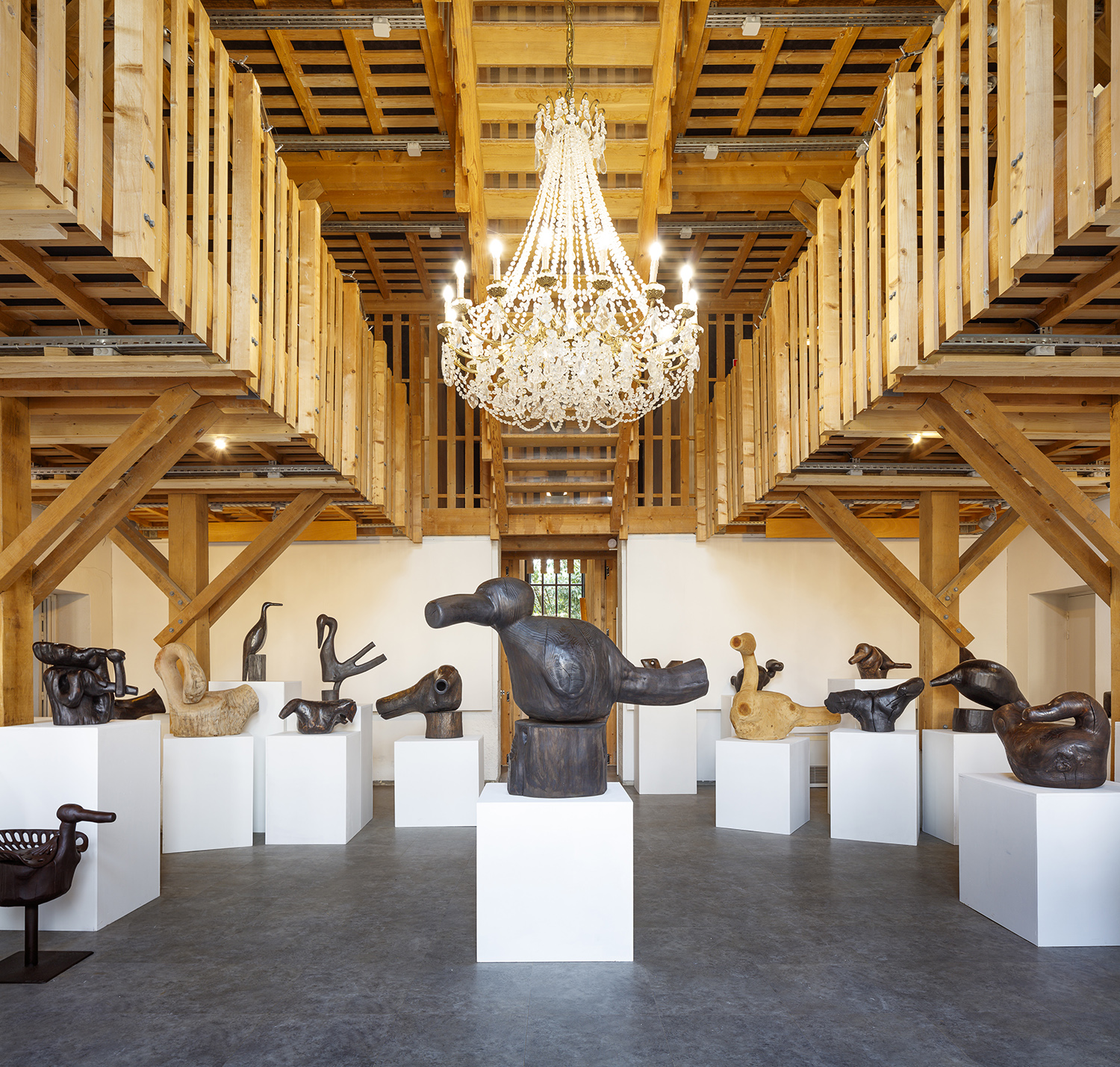
The self-taught Chinese artist Wang Keping has lived in France for many years. He has always used traditional Chinese techniques for his fire-blackened wooden sculptures. His work embraces and channels the properties of the wood he chooses in an aesthetic and spiritual quest inspired by Taoist philosophy, the ancient statues of the Han dynasty (206 B.C. – 220 B.C.), and the folk art of rural China.
The rounded, voluptuous forms of his sculptures are polished and dark, almost black, with a patina that deliberately allows the grain and cracks of the wood to show through. He likes to respect the original form of his material.
He has a passion for what he calls “the flesh of the forests”. He follows the natural curves of the wood to create extremely sensual forms. With their figures cut through the middle, like trunks, his sculptures appear to be rooted in themselves. “Each piece of wood makes me feel something, inspires me,” he says, “I see the shapes in the wood”, and, “the shapes live in my imagination.”
He works from the veins, knots and clefts of the uneven surfaces of the pieces of wood, from which he creates the fundamental forms of his subjects. Each log is thus expertly chosen and its integrity is respected.
This primordial relationship with nature, his primary source of inspiration and the mould of the shapes he works with, can also be seen in the care and attention that Wang Keping gives to the surface of his works. Several stages contribute to creating this smooth, soft surface that cries out to be touched. The sculptures are first polished to remove all traces of the tools that have been used and to ensure that only the inherent surface of the material is visible. They are then meticulously burnt with a blowtorch to obtain a final hue that is unique to each sculpture. This treatment accentuates the sensuality of his work, created by the suggestive lines and voluptuous curves, the harmonious nature of which brings authenticity to the works.
Wang Keping started his series of Oiseaux, (Birds - Harmony of the Forest), in 1982. He sees birds within the trees, through their branches. The creatural forms are an abstraction of actual birds and allow him to reveal the details of the wood and the textures they can lend to the sculpture.
BIOGRAPHICAL NOTES
Wang KEPING
CHINA


Wang Keping was born in China in 1949, the year that the People’s Republic of China was created. Self-taught, he began sculpting wood in 1978 and became co-founder of one of China’s first contemporary art movements, the Stars Group. Their work gave voice to the Chinese revolution at a pivotal moment in its transformation, following the end of the cultural Revolution and the death of Mao Zedong. The first exhibition by the Stars Group was not officially authorised: the artists displayed their work on railings outside the China National Art Gallery. They were removed by the police two days later. The artists then organised a protest march demanding the freedom to create. A year later, the same group of artists was invited to exhibit inside the museum. Wang Keping’s works were among the most politically engaged of the group. His sculpture Silence showed a man who was blind and deaf as an analogy for the age. Another work, Idol was perhaps the first to dare to caricature Chairman Mao, who was depicted as a Buddha. Along with Huang Rui and Ma Desheng, he was one of the leading members of the Stars Group. In 1984 he went into exile in France and moved away from political work to concentrate on the simplification of sculpture, both figurative and abstract. Inspired by the smooth lines of the modernist Constantin Brancusi, the elegance of the Chinese Han dynasty and the rawness of African sculpture, Wang Keping has followed a unique and completely personal path in sculpture for the past 40 years.
Since 2017, Wang Keping has been represented in Paris and Brussels by the Nathalie Obadia gallery. He has been represented in Hong-Kong by the 10 Chancery Lane Gallery since 2001. From 1986 until 2016 he collaborated with Galerie Zürcher (in Paris and New-York).
WANG KEPING