ARTISTIC APPROACH
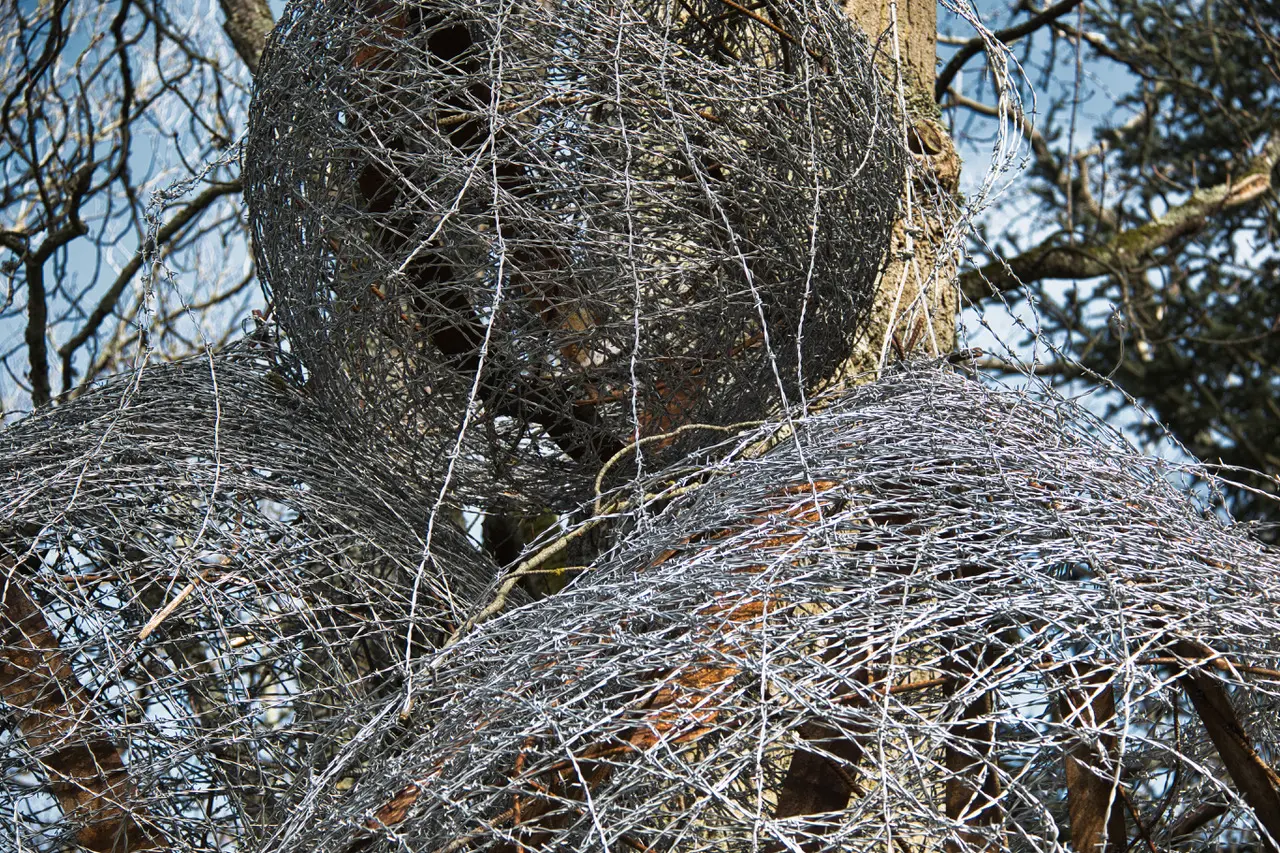
Created for the Domain of Chaumont-sur-Loire, Renaissance takes the form of barbed-wire nests installed in the trees of the Historic Grounds. The nest evokes shelter, protection and birth; barbed wire recalls separation and confinement. By bringing them together, the artist transforms a material associated with constraint into an image of new life.
This approach is rooted in Abdul Rahman Katanani’s personal history. Born and raised in the Sabra refugee camp in Lebanon, the Palestinian artist works with materials drawn from his everyday surroundings: barbed wire, corrugated metal, wood and reclaimed petrol cans. Transforming them gives new form to an experience that is both individual and collective.
These materials become monumental waves, silhouettes of children, olive trees or installations such as Camp, an evocation of a refugee camp presented at Danysz gallery in 2017. For him, the care devoted to form is “a way of drawing the eye”. The beauty of the works thus opens up possibilities for encounter and discussion around the realities they evoke
Movement is central to his work, in which the motifs of the spiral, the whirlpool and the tornado recur. Katanani describes the Palestinian cause as “a tornado that sweeps up joys, dreams, energy and people, and spins towards the unknown”. This vision conveys a world in perpetual transformation, where stillness can become a form of confinement
For the artist, creation opens the way to freedom. By shaping barbed wire, he explores geographical boundaries as much as the mental barriers each of us carries within. His experience informs a reflection on the possibility of moving beyond these limits. With Renaissance, this exploration takes the form of a nest, a symbol of a new beginning
BIOGRAPHICAL NOTES

Born in 1983 in the Sabra refugee camp in Lebanon, Abdul Rahman Katanani first became known as a teenager for his satirical drawings. He continued his studies at the Beirut School of Fine Arts, where he earned a master’s degree.
His work has been presented in numerous institutions, including the Cité internationale des arts and the Arab World Institute in Paris. His works are held in public and private collections, including the collection of Mathaf in Doha.