The garden
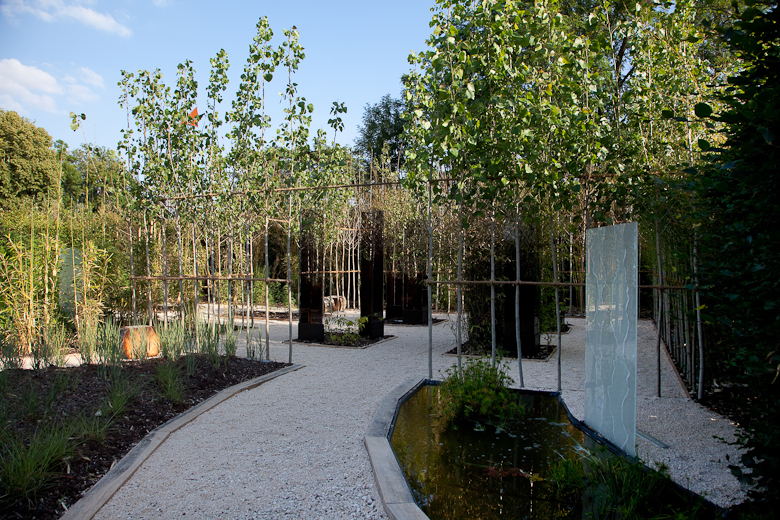
With this relationship between the body and the mind as their starting point, the Franco-Japanese artistic couple and the two architects who work with them imagined a garden where the pathways form the ideogram of the soul: “Tamashi”.
The garden offers paper artworks made with mulberry bark. Only plants used to make paper were chosen (bamboos, hemp, grasses, poplar, papyrus). The absence of flowers contributes to stressing the vibratory effect caused by the leaves and their shades of colour.
Serenity, peacefulness, communion with nature are the spiritual drugs of the soul. Quite the contrary to dry gardens, which are contemplated from outside, in this garden the vegetation protects visitors from the world and invites them to approach paper in a really original way, both through the artworks and the vegetation. Like in a Zen garden, the gravel on the paths symbolises the water in the river, resonating with life as it passes by. Three benches placed in the centre of the garden and on the fringe of the paths encourage visitors to take a break for contemplation.
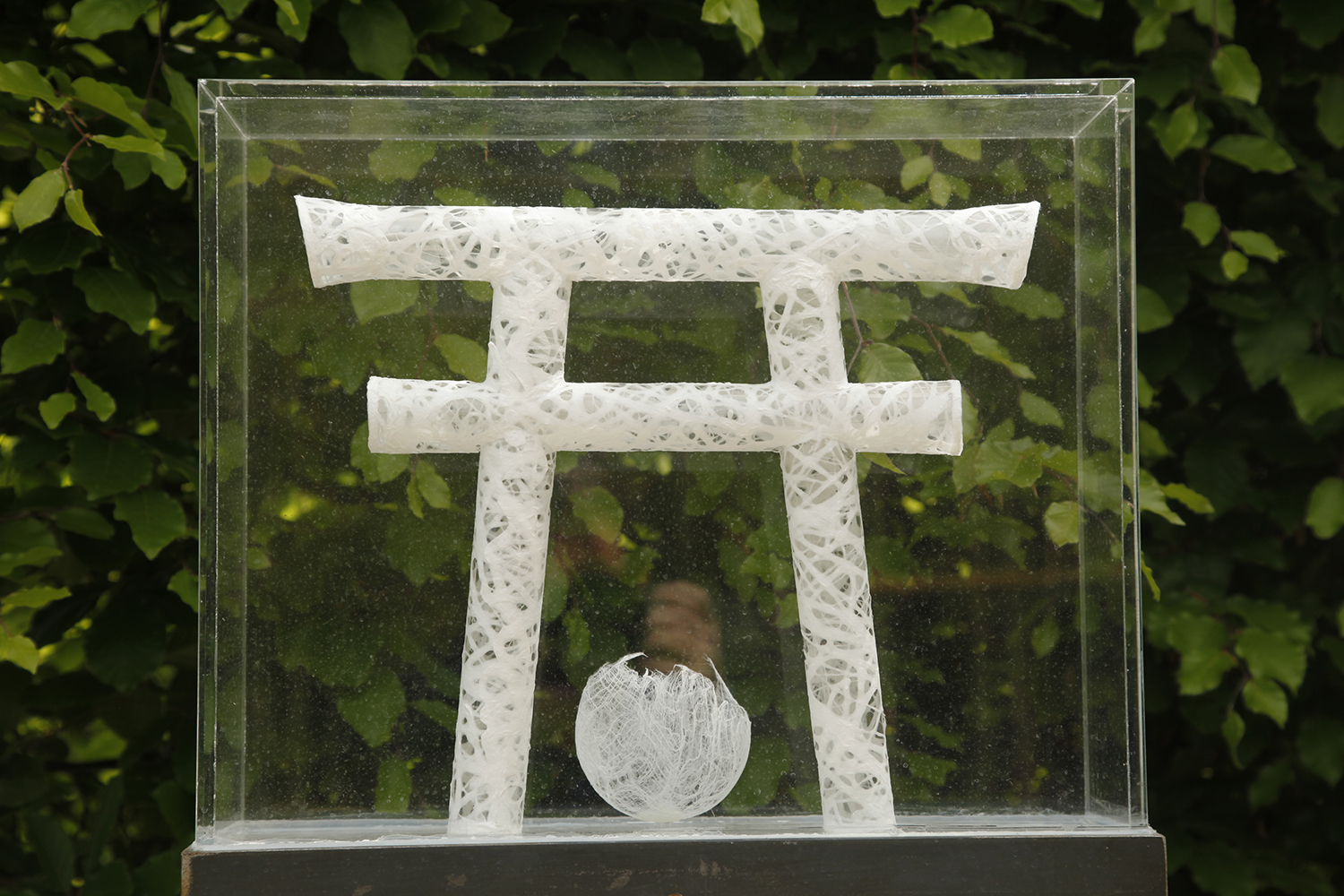
Miki Nakamura uses the phloem from trees; it is the part between the green bark and the core, the network of channels used by the sap, the living part of the tree that enables it to grow. The artist’s work highlights this network, which becomes the structural framework for her creations.
Torii: literally: “where the birds are” is a traditional Japanese gate whose function is the symbolic separation of the physical and spiritual worlds; each torii you pass through when entering a temple must be passed through again, in the opposite direction, to come back into the real world. The artist has left an offering at the foot of the Torii as a symbol of the soul escaping from the body.
Awa: bubbles. The bubble installation is presented in contemporary bamboos (tubes in acrylic resin) and is a reminder of the importance of the oxygen released by plants.
Flowers: the only flowers in the garden. An evocation of fragility and impermanence.
DESIGNERS

Miki Nakamura was born on 1 June 1974 in Hiroshima. After finishing her studies at the Osaka Fine Arts School, she learnt the techniques of papermaking for 3 years. Following this traditional apprenticeship, she travelled to China and then Europe, with the aim of finding methods more suited to creativity. It was finally in the studio of Jean-Michel Letellier, who she had met in Japan a few years earlier, that she began work with fibre (mulberry tree bark) before it was transformed into pulp. For several years she has been exhibiting on her own and as a duo.
Jean-Michel Letellier was born on 8 January 1954 and he lives and works in Trélazé (Angers). In 1997, he decided to set off for Japan to learn about making “washi” (Japanese paper), in 1999 he got the grant from the Ministry of Foreign Affairs for the KUJOYAMA Villa in Kyoto. In 2001, he set up his studio in France and began by creating large formats of more than 4 m2. During one of his numerous trips back to Japan, he discovered a method which enabled him to draw with pulp, and began a paper series on the theme of plants, where the sheet extends in an interlacing of rhizomes.
Michaël Ripoche lives and works in the Angers region. He studied landscape architecture in England and in Angers. After graduating from the ENITHP [National Institute for Engineers in Horticultural Techniques and Landscape in Angers] and in Landscape Architecture Graphics from the Florian Vocational Training Centre, he cofounded the Vu d’ici Agency in 1998, specialising in regional and impact studies, landscape developments and gardens.