Artistic approach
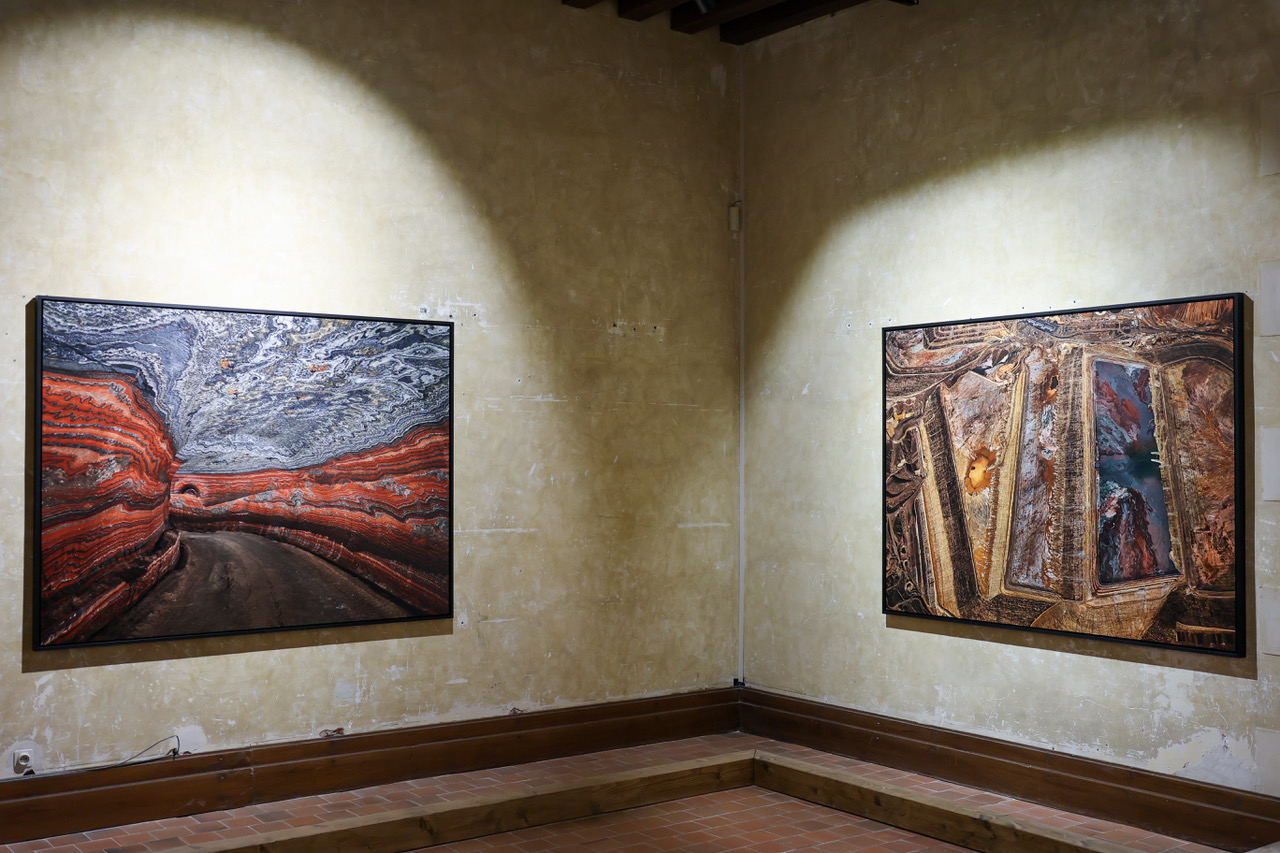
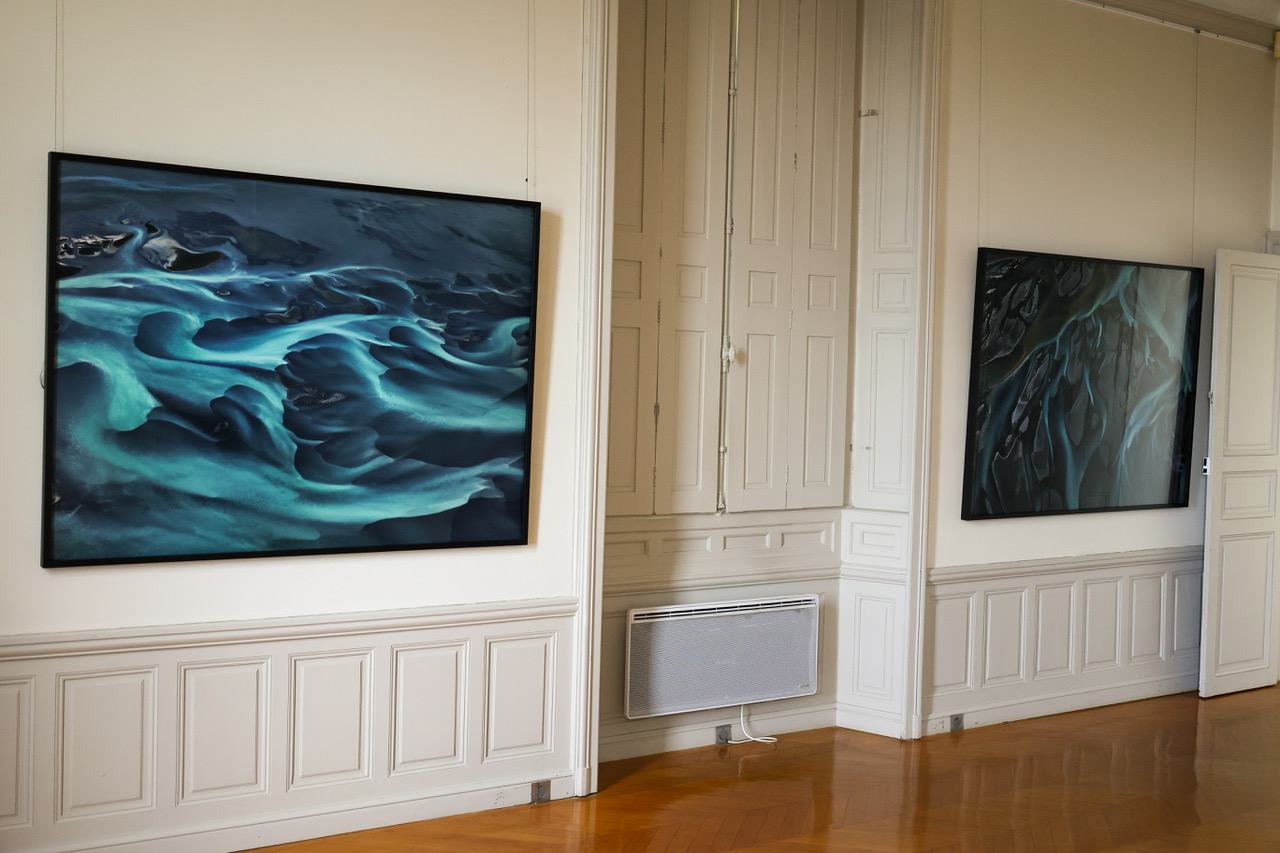
The photographs being exhibited at the Domain of Chaumont-sur-Loire are from the series Water and Anthropocene, and are typical examples of the work of Canadian photographer, Edward Burtynsky. He is committed to defending the environment through art. Since his beginnings as a miner, labourer and photographer, his lens has been focused on what he calls “Industrial landscapes”, or those which bear the scars of human activity (quarries, oil fields, etc.). The second common feature of the sites he photographs is their breathtaking beauty - at least from the air, since aerial photography allows him to capture the sheer wonder of these places. His intention is clear - he creates images using many eye-catching elements (bright colours, abstract-like harmony of forms, use of huge formats where the gaze can be absorbed and, thanks to the high resolution, get lost in the abundance of details) to hit home. The object of this work, which is born out of an ethical as well as an aesthetic imperative, is not to please. The aim of beauty here is to make people wake up. “Through art, human beings can be made to be much more aware of the impact of their actions,” points out Burtynsky.
He is driven by the conviction that the wounds inflicted on Earth are the result of ignorance and that this ignorance separates people from reality and locks them into artificial, inward-looking worlds. However, Burtynsky believes that the knowledge that we are linked to damaged ecosystems as well as to those who are directly affected by them can lead to a change in our view and consequently our actions. The artist does not take an accusatory stance. It is instead more that of an educator. “I like to work on large formats and wide, flat areas. When you stand in front of them, you can feel a kind of physical, sensory experience. You have the sense that you are soaring dizzily above the landscape and are developing a special relationship with the place depicted. Many people say that these images are awful. That is true. They depict disaster. But so are our cities and the buildings we live in. What you are seeing is our everyday life! I want to show you that these worlds are our reality. You cannot live in a city or buy a car without extracting copper or iron, or without creating plastic. Everything is so closely connected. That is what I want to talk about.”
The images exhibited at Chaumont, some of which are devoted to water (one of the many resources), and others to the scientific concept of the Anthropocene, which is at the heart of current ecological issues, speak for themselves. The Water series is astonishing in its diversity, and a far cry from any perceived idea of uniformity surrounding the element which is the source of life on earth. Burtynsky wants us to “Understand water” in the complexity of its relationship to man, “What it is and what it leaves behind when we leave - our use and misuse”. As Russell Lord, the Curator of Photographs at NOMA (New Orleans Museum of Art) writes, “The project takes us through excavated landscapes, fractal-patterned delta regions, menacingly coloured biomorphic forms, rigidly stepped and rectilinear wells, massive centre-pivot irrigation plots, aquaculture and social, cultural and ritual gatherings Water is repeatedly introduced as a victim, partner, protagonist, illusion, source, an end in itself, threat and pleasure. Water is also often completely absent in these images. Burtynsky instead concentrates on the visual and physical effects of a lack of water, which makes its absence all the more powerful.”
The term ‘anthropocene’ comes from the Greek anthropos, ‘human being’, and kainos, meaning ‘new’. It first appeared in the early 1990s, having been coined by Paul Crutzen, a Nobel Prize winner for chemistry. It refers to a period in Earth’s history which would have followed the previous geological time (the Holocene) when the influence of human activity on the Earth and its systems have become dominant and its impact irreversible. The concept focuses on the traces left by man in the geological strata in particular. This theme has been important to Burtynsky since his first studies in quarries, revealing in cross-section the depth of past eras and the explosion of changes brought about by man. The photographs in the Anthropocene series are at the centre of a project which spans several disciplines. The Anthropocene Project has come about through the collaboration of Burtynsky with filmmakers Nicholas de Pencier and Jennifer Baichwal, and is structured around three main elements. These are the film ANTHROPOCENE; the exhibition, The Human Epoch (2018) - an immersive experience using cutting-edge technology such as Gigapixels, organised with the National Gallery of Canada, the Art Gallery of Ontario and the Fondazione MAST (Bologna); and a book (Steidl, 2018).
Exhibiting these photographs in Chaumont, which is a centre for exchanging ideas across disciplines, is fully in keeping with the spirit of the project. This is driven by the desire to bring ecological issues to the attention of as many people as possible.
BIOGRAPHICAL NOTES

Edward Burtynsky was born in 1955 in St. Catharines in the Great Lakes region of Canada. He grew up in an industrial world as his father worked at General Motors. As a teenager, he experienced the unspoilt natural world and the wilderness. “This experience left a lasting mark which has always influenced how I respond to landscape,” he wrote in Anthropocene (Steidl, 2018). Burtynsky began work in the mines and the factories at Ford and General Motors. His first photographs, which were of quarries, were the result of this world. In 1982, he was awarded his degree in photography and in 1985, he founded the company Toronto Image Works (TIW). His passion had become his work. As a photographer, his initial drive was to show to as many people as possible the realities on which we all depend, but which still remain alien to the majority. His ‘industrial landscapes’ started out as “A great way to reconnect to these worlds”. At the turn of the millennium, reading and listening to others proved to be “A catalyst” in that the fundamental question raised by these places was that of the consequences of human activity on the planet. From that moment on, his photography served an ecological purpose. Burtynsky has the means to reach a wide audience as TIW has become a major training and exhibition centre, his 3D printing company Thing2Think created in 2014 allows breathtaking images to be created and, since 2015, the multidisciplinary Anthropocene Project (founded together with two filmmakers) combines photography, lectures and immersive exhibitions. His work is included in the collections of over 60 museums throughout the world.
Edward Burtynsky is represented by the Nicholas Metivier Gallery, Toronto (Canada).