Artistic approach
LIEU DE RÊVE
Located facing the Loire, at the foot of the slope, the black granite armchair encourages silence, meditation and contemplation. On the back of the chair, the golden engraving of an elliptical labyrinth, which is reminiscent of a brain, gives it a sacred quality. Like the fragment of some buried remains rising out of the earth, it is the memory of a fictitious archaeology, unveiled by Anne and Patrick Poirier. Playing on the idea of being both architects and archaeologists, with this block of stone the artistic couple mark the place where Chaumont’s first church might have been built.
CAPELLA DANS LA CLAIRIÈRE and L’ŒIL DE LA MÉMOIRE
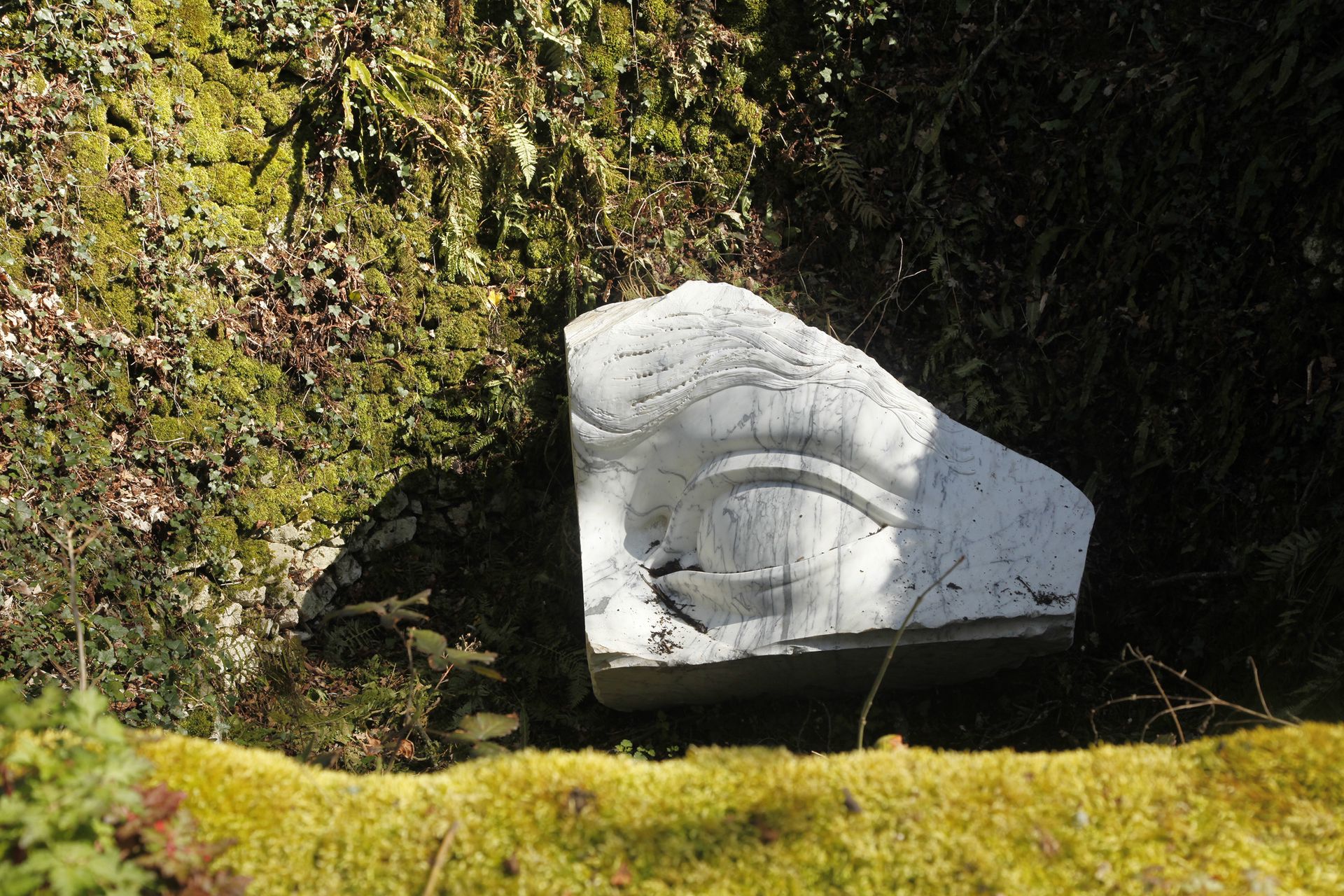
The Poiriers’ chapel is presented like architecture that has been unearthed by archaeologists. “During their reading, the archaeologists’ attention had been attracted by a site in the Grounds a long way from the Château, where they concentrated their search: a small clearing in the middle of wild lime trees in an area of the Domaine that was half abandoned. It is true that, if you went into the shapeless undergrowth, you could make out large fragments of white stone that had fallen onto the ground as if ripped apart, torn down according to a precise design. This was in keeping with the allusion made in the archives to the presence of a small building (chapel? oratory? hermitage?) that nobody had been able to find until then. Excavation work was undertaken, in spite of the harsh and misty winter of 2010, and 8 large steles, 3 metres high by 1 metre 40 wide by 20 cm thick, were freed from the earth and ivy, which were keeping them almost entirely hidden away. On the cleaned visible surface you could read a series of words, which when taken end-to-end seemed to form a sentence. In the middle of these remains, they also discovered a large stone brain covered with a thin layer of gold. The archaeologists decided to stand the steles back up according to the position where they had fallen down, which made a sort of small structure (gazebo) referred to in the texts by the name CAPELLA. Ten or so metres away, covered by creepers and moss, buried under ivy, they uncovered a huge, marble monolithic block. An inscription that was barely legible, in tall antique letters, said: OCVLVS HISTORIAE. Once the block had been cleaned up, they were surprised to discover a gigantic eye looking at them, a look defying time, the remains of a cult, a culture, a forgotten memory. The look of a gigantic broken statue. Another Vanitas?”
L’ŒIL DE L'OUBLI
It was by uncovering this hollow building called “the Ice-House” that the archaeologists discovered a gigantic eye in white “arabescato” marble lying at the bottom of the huge funnel-shaped hole, as if it had fallen from the sky. A huge eye looking at space, time, the sky, capable of seeing the infinity of time, the infinity of the sky, the infinity of space … You can imagine the amazement of a walker in the spring, when the snow piled up at the bottom of the cone began to melt, slowly uncovering this white look fixed on the sky, this eye of memory and forgetfulness, eye of History, of the violence of History, hurled down there with unheard of violence...
biographical notes
Anne and Patrick POIRIER
FRANCE

Anne Poirier was born on 31 March 1941 in Marseilles and Patrick Poirier on 5 May 1942 in Nantes. They now live at Lourmarin in Vaucluse. After studying at the Paris Decorative Arts School, they were resident artists at the Villa Médicis from 1967 to 1972. Right from the start of their time there, they decided to work together and to pool their ideas and sensitivities.
Anne and Patrick Poirier are true travellers through memory, which they consider to be the basis of all intelligence between human beings and societies. They explore sites and remains from ancient Greek, Roman, Mayan and Indian civilisations and bring them back to life through models and reduced scale reconstitutions. They are sculptors, architects and archaeologists, all at the same time. They are interested in the psyche and continuously strive to understand its structures through a variety of metaphors.
Using mythological tales as an inspiration and by exploring real or imaginary cities, the work they create together is a metaphor for time and memory. Past and future are closely intertwined, giving us a picture of the fragility of cultures and human beings.