Artistic approach
Christian Lapie’s body of work examines out individual and collective memory. His installations of spectral figures rise up from the earth in selected venues steeped in history, making them their own, filling them with strength and serenity. Armless and faceless, silent and powerful, they question and destabilise. Because they are trees, Christian Lapie’s men are often huge, towering over their beholders, without alarming them despite their stature and darkness, testifying to the sense of tranquillity and peace aroused by the company of trees. In groups, the sculptures resemble placid, changeless sentinels. They watch over a buried past, embodying the presence of bygone humanity.
“Born into a family from a little village in Champagne, near Reims, Christian Lapie started out by developing a pictorial approach drawing on the memories of a land with a painful history. Over time, he moved from surface to volume, creating imposing figures whose symbolic strength vies with their universal value. His work has made its way beyond the microcosm of Champagne, knowing no geographical or cultural borders. Powerful and silent, Christian Lapie’s figures are extracted from massive tree trunks, which he selects for their straightness and shapes into human form with a chainsaw, finally applying a dark coating that imbues them with timelessness. Installed in groups or alone, depending on how and where he has been asked to intervene, the artist sets them upright and, in the blink of an eye, the site makes them its own. At once hieratic, spectral and momentous, Christian Lapie’s sculptures act as semaphores, highlighting the spirit of the places they occupy”, the art critic Philippe Piguet writes.
Sombre, timeless figures, strange yet protective, Due to their extraordinary, universal presence, Christian Lapie’s sculptures cannot fail to capture the beholder’s attention. Starting out life as a painter, he used chalk, oxides and ash on coarse canvas tarpaulins mounted on rudimentary frames. His materials evolved over time, to include sheet metal, cement and charred wood, his elementary, even rudimentary work techniques capturing the unforgettable image, both near and distant, of an irreducible “being in the world”. By force of circumstance, artists who devote themselves to acting on the landscape are nomadic artists. Christian Lapie is no exception to the rule: over the last dozen years, he has been asked to intervene all across the world, including in Japan, France, Canada, Belgium and India.
“My sculptures aren’t object-works. Each work is a response to an invitation. I always work in conjunction with the people who invite me. The important thing is to be invited somewhere so I can consider and create these figures in a new context. Customers come to me and tell me what they want, describing their land, their history, their family, their forest, and so on. As for me, I give myself time to imbibe it all, get things ready, and suggest how the figures might be arranged spatially so that the magic works. There must be a human aspect to my work, absolutely. Without the human aspect, it doesn’t work. Anyway, if I didn’t have projects, I wouldn’t create works. All my works are created for projects. There’s always got to be a human relationship,” the artist explains.
First invited to exhibit his work in 2015, Christian Lapie installed La Constellation du fleuve in the Domain of Chaumont-sur-Loire’s Historic Grounds. A sculptural ensemble composed or a dozen enigmatic characters, the work is perhaps suggestive of the totemic statues erected by bygone societies here and elsewhere. These silent, benevolent guardians have become emblematic of the Domain and will not be leaving it. The artist’s gift is celebrated this year by the presence of several of his other pieces.
BIOGRAPHICAL NOTES
Christian LAPIE
FRANCE
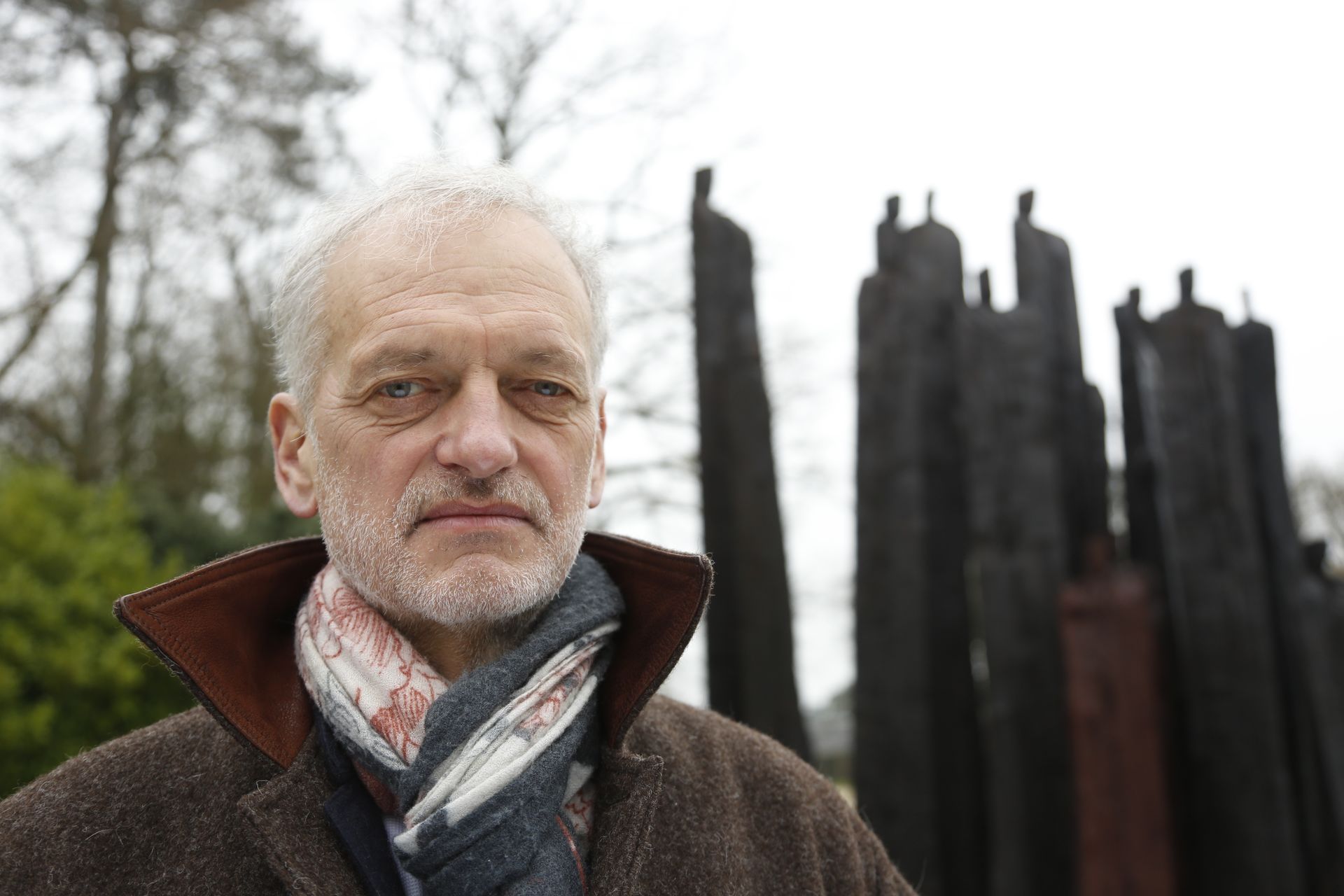
Christian Lapie was born in Reims in 1955. After studying at Reims School of Fine Arts (1972-1977) and then at the National Higher School of Fine Arts in Paris (1977-1979), he set up his studio in Champagne, his family’s home region.
His practice evolved, driven by his desire to make the scars left by the First World War visible. From subtle, carefully elaborated wax paintings, pigments became raw, combined with sediments collected on the former battlegrounds, chalk, oxides and ash, which he applied to coarse canvas tarpaulins mounted on rudimentary frames. Traumatised by the new wars being waged (the Balkans and First Gulf War), Christian Lapie introduced a sense of brutality into his work through combinations of materials: charred wood, broken glass, cement and inscriptions on sheet metal, species of bas-reliefs like In Case of War (1990) at the Australian Centre for Contemporary Art in Melbourne (Winner of the Villa Médicis Hors les Murs award). Aware of his involvement, several German museums and galleries, including venues in Aix-la-Chapelle, Essen and Frankfurt, invited him to exhibit.
In 1992, the Goethe Institute in Brazil invited him to take part in the Arte Amazonas collective exhibition at Rio’s Museum of Modern Art, held in counterpoint to the United Nations Conference on the Environment and Development. He stayed in the heart of the Amazon rainforest, in a studio made available to him in Porto Velho. His encounters with the Caboclos living along the Rio Madeira threw him completely off balance. This people, whose dignity was so much in contrast to the lives they lived, reduced to essentials, forced him to look afresh at his role as an artist, his practice and his engagement. In 1995, the Ministry of Culture and Reims’ Museum of Fine Arts commissioned an installation from him to mark the anniversary of the German Surrender, which had been signed in Reims. The work War Game was deemed too subversive and never exhibited.
Following these two events, Christian Lapie produced writings addressed to the Caboclos, city dwellers and Japanese and Indian farmers among others, along with art lovers, urging them to break free of local and national cultures and create dialogue between one region and another, one continent and another. The tree, rising skywards to connect earth and heaven, was the obvious choice. For the last twenty-five years, the artist has been selecting them in the forests. Their trunks arrive at his workshop, where he splits them open by hand, following what the trees themselves suggest to him. He then uses a chainsaw to extract cursory human forms from them, like upright shadows.
Although his first works were specifically created for Champagne’s wounded lands, Christian Lapie has been installing his black figures across the world since 1995: in the Echigo-Tsumari sculpture park in Japan, as well as in France, including at the Salomon Foundation, Reims Museum of Fine Arts, the Historial Jeanne d’Arc in Rouen and the Parc de Sceaux, and in numerous public and private collections in Europe, the United States and Africa. Wherever they are, they hold up a mirror that reflects humanity, past and present.
Christian Lapie is represented by the RX Gallery (Paris-New York) and the Alice Pauli Gallery (Lausanne).