Artistic approach
“At the time we were commemorating the centenary of the First World War, I wanted to pay tribute to the hundreds of thousands of soldiers who lost their lives on its battlefields, no matter what their nationality. In the Somme, in Alsace and in Verdun, the theatres of operations saw Europe’s nations slaughtering each other, thereby creating our common historical core. Without recourse to artifice or picturesqueness, I watched nature take over once again, thinking of the thousands of corpses still buried in these lands. I would like to think that the portraits of trees presented here are as much portraits of soldiers who died fighting, each with his own story and personality.” Denis Darzacq
BIOGRAPHICAL NOTES
Denis DARZACQ
FRANCE
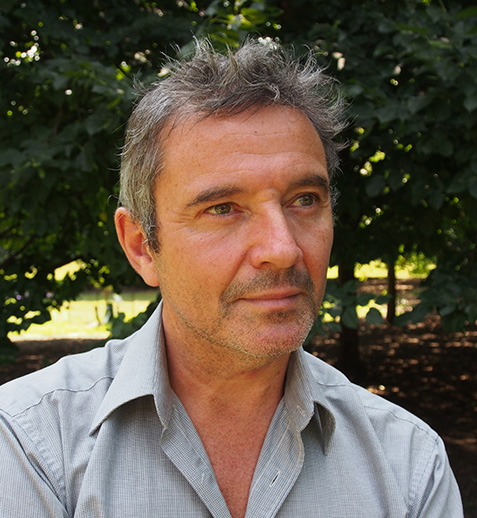
Born in 1961, Denis Darzacq lives and works in Paris.
Graduating from the video section of the National School of Decorative Arts in 1986, he started out as a photographer of the French rock scene, also becoming studio photographer for many feature films (Satyajit Ray, Jacques Rivette, Chantal Ackerman, etc.)
From 1989 onwards, he was a regular contributor to the daily newspaper Libération and, more generally, to the national press. He became a member of the VU agency in 1997.
He began to develop his own personal work in the mid-1990s. From press photography, which, as it did for other French photographers of his generation, provided the cradle for his artistic practice, he above all retained a keen eye for contemporary society and a work method. The artist knows the importance of spending ample time in the field in direct contact with his subject, but he is done with reporting and its value as testimony, adopting a more analytical approach in its stead that gives rise to formally extremely coherent series. Although the close-ups in the “Only Heaven series, 1994-2001”, still reveal a measure of personal involvement on the part of their author, the bird’s-eye views of “Ensembles, 1997-2000”, front views of “Bobigny town centre, 2004”, and “Casques de Thouars, 2007-2008”, express a distancing from the subject, perhaps even an artist in retreat.
Denis Darzacq has above all come to the conclusion that a constructed image may, paradoxically enough, serve his analysis of society more effectively. Since 2003, he has also resorted to mise-en-scenes based on the principle of disruption, where the state or posture of the bodies pictured upsets the established order, without ever over-dramatizing the results. Men and women walk naked through the suburbs (“Nus, 2003”), others seem to hang weightlessly in urban space (“La Chute, 2006”), or between supermarket shelves (“Hyper, 2007-2011”); the disabled take violent possession of public space (“Act, 2009-2011”).
In the “Recomposition I series, 2009”, digital editing, which the artist had not previously used, enabled him to take his disruptive stagings yet further. With the exception of more abstract motifs – the reflections of light sources in “Fakestars, 2001-2003”, or the still lifes of “Recomposition II, 2011” – which express the same sense of observation of signs of the contemporary world, the body appears as a common denominator in Denis Darzacq’s research.
The artist conceives it as a sculpture. A social sculpture, however, for the body cannot be extracted from the context in which it is incorporated. The artist uses it as a tool for a critique of the difficulties and stigmatisations that certain groups come up against, in particular young people from disadvantaged neighbourhoods and relegated areas, more generally speaking, as in “Act”, those on the margins of society. Denis Darzacq highlights social constraints and contradictions. But through rupture of actions devoid of meaning, he also invites us to affirm an identity ever more complex than that allocated to us, and to recapture a form of freedom in places where it would seem to have disappeared.


