Artistic approach
Nature is a recurring theme in the history of art, as it is in the work of Miguel Chevalier. The artist uses new technologies to transpose, reinvent and enhance it. In a poetic and metaphorical way, he explores the question of the link between nature and artifice, coexisting and mutually enriching each other. His approach, which began in the late 1990s, is based on observing the plant kingdom and transposing it into the digital universe through imagination.
Based on scientific studies, the artist creates specimens that do not exist, but whose growth is modelled on that of real plants. This research has produced different generations of virtual herbariums, enabling him to orchestrate gardens that adapt to a wide range of environments. “These works bring us face to face with an intriguing natural world and immerse us in a dreamlike universe. They capture the beauty of nature, an inexhaustible source of imagination, and illustrate humanity’s enduring desire to appropriate it. They seek to create the conditions for symbiosis between humans and this reinvented nature,” explains the artist.
Flowers, branches, leaves and other buds appear, unfurl and vanish, forming paintings that are instantly and infinitely transformed as soon as they are created. The best part is realising that what you see is unique. Digital technology makes it possible to create generative works that never return to their point of origin, offering each visitor a brand-new painting. The virtual gardens evolve, not just with the seasons, but continuously.
The work on display in the Digital Gallery at the Domain of Chaumont-sur-Loire is titled “Meta-Nature AI Quatre Saison” 2025. It uses a database of different species of trees, leaves and flowers, in 2D and 3D, realistic or abstract, and, for the first time, enriched by images of flowers and leaves generated by a text-based AI model. The wide variety of species, with striking visual beauty and iridescent and pearly reflections, appear at random and blossom before disappearing.
In harmony with the music, a mysterious swirl of vegetation renews and transforms the garden with the cycle of the seasons. In spring, as sap flows through the plants, evanescent streams of light permeate the composition. Energy is the prelude to the rebirth of nature. As if by magic, the trees are covered with prolific foliage, and giant leaves in exotic colours unfurl. Exuberant nature evokes the jungle in Henri Rousseau’s paintings.
Summer brings giant trees full of life, loaded with fruit and saturated with colour. Fertile nature is on display, as marvellous and fantastic as an Arcimboldo painting. Then, swarms of flowers appear to the sound of buzzing, a reminder of their essential role in sustaining biodiversity. Shining vibrantly, they fill the space in a majestic explosion of colour. The intense yellows, reds and browns of autumn follow. The trees lose their leaves. Huge, ribbed, luminescent leaves swirl together, overlapping and creating astonishing transparent effects. They fly with the lightness of feathers, before being carried away by the autumn wind. Winter has arrived, strikingly strange. The bark of trees is bared, giving nature a supernatural and magnetic presence.
“Meta-Nature AI Quatre Saison” 2025 is a digital extension of Impressionism. The artist drew on his research into light, time and nature, as exemplified by Monet’s Water Lilies, and took inspiration from the great painter’s cosmic sensibility. Each element has an artificial life of its own, part of a sumptuous ballet of plants in which the public is invited to immerse themselves. Breaking with the traditional presentation of paintings, Miguel Chevalier offers a truly unique “immersion in nature”, continuing the avant-garde research of great 20th-century artists in his own way, seeking to place painting in another dimension.
Music and software Claude Micheli.
BIOGRAPHICAL NOTES
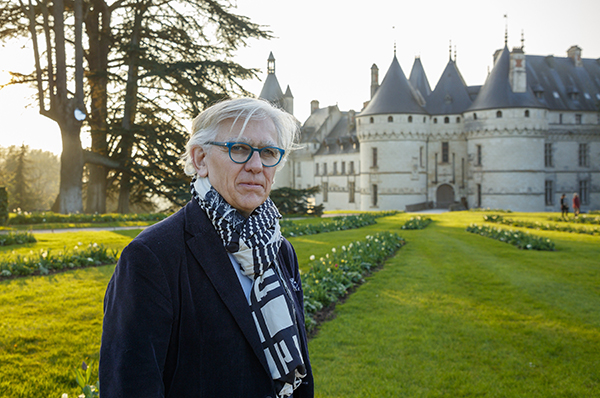
Born in Mexico D.F., Mexico, in 1959, Miguel Chevalier graduated from the École Nationale Supérieure des Beaux-Arts in Paris and the École Nationale Supérieure des Arts Décoratifs. Since 1978, Miguel Chevalier has been using computer technology as a means of expression in the realm of visual arts. He is internationally acknowledged as one of the pioneers of virtual and digital art. His multidisciplinary experimental work has its sources in the history of art, whose essential data he reformulates. His work tackles the question of immateriality in art, as well as such computer-driven logics as hybridisation, generativity, interactivity and networking. He focuses on a range of themes, including the relationship between nature and artifice, observation of the flows and networks that organise today’s societies, imaginary architecture and virtual cities. His projects include virtual reality installations projected on a large scale or shown on LED or LCD screens, sculptures made with 3D printing or laser cut-outs, holographic images and other works using AI. Miguel Chevalier has created exhibitions and installations for museums, art centres, galleries and public spaces all over the world. His works are in a constant state of metamorphosis, plunging us into a world of very contemporary magic and constantly questioning our relationship with the world.
Miguel Chevalier is represented by The Mayor Gallery, London.


