ARTISTIC APPROACH
“I am composed of the landscapes that I cross and which cross me. For me, the photographic image is a receptacle for forms, energy and meaning.”
A photographer with a career going back 30 years, Éric Bourret spends his life roaming “natural” regions in order to report on the movement that brings them to life. His long walks and the unique photographic records he brings back result in series that all have connections with the landscape’s memory. “The memory of places is more alive than that of the entombed mortals who erected them to their own glory at the price of the sweat and blood of slaves weighed down by blocks of stone and breaking their backs piling up dressed rocks – pyramidal Meccano or labyrinthine maze where the echoes of the higher voices captured by the photographer’s hieratic lens wander and lose their way”, writes the photography critic Patrick Roegiers, referring to a walk undertaken in the land of the pharaohs.
Viewed as the photographic notes of a score encompassing whole landscapes, Éric Bourret’s images bear witness to subjective experience. The artist-walker spends more than 6 months a year travelling, not only in France, Provence and Pays de Loire, but also in China and South Africa’s primary forests. “Whether you’re in the Himalayas or the High Alps, walking is an invitation to austerity. It can also be a philosophical act and a spiritual experience. […] The photographic machine records the experience of the landscape crossed and makes it visible. The photograph transcribes the flows that bring the landscape to life, like those that bring our own bodies to life. […] Physiologically, walking for eight hours a day gives rise to a whole new attitude to space and keeps you in excellent condition. So much so that, in the end, I don’t really know if I’m seeing with my eyes or with my body”, Éric Bourret explains, on the occasion of the exhibition currently underway at the Lodève Museum in Hérault.
During these walks, the artist takes numerous photographs following very specific protocols. He seeks to capture the constant flow that invigorates the landscape, the vibrations of an energy in the very heart of the land, and then strives to dispossess himself of the result. Each image must reveal and escape, causing a sensation of light-headedness, which the photographer sees as a sign that “it touches upon reality”, as the sociologist Gilbert Beaugé explains, going on to say that “For an image that is sufficient unto itself, Éric Bourret speaks of ‘culmination, ‘strength’, ‘implacability’, ‘a life of its own’, and above all of exceedance is-à-vis himself.”
Hence, the photographer loses himself in very personal contemplation of the landscape without every trying to document it. He seeks to explore the poetic and extremely powerful overflowing of energies that he discovers in the heart of nature. “You might say that the photographer looks at the landscape like a land artist, but without direct intervention and without appropriation. He doesn’t touch it; inside, he seeks the benchmarks of its progress. He wanders like the falling snow. He lets himself be touched by a tangible array of forms and materials, with acute perception of the spaces within space. He is right inside, anticipating the possibilities provided by the experience of the walk and the visible”, the writer and art critic Sophie Braganti emphasises. This meditative poetry draws on the explorations of land art, minimal art and performance art. Celebrating the way in which the landscape’s components interlock with each other, the artist seeks to reveal nature as a creative power like art, whether the eye focuses on the microcosm or the macrocosm. “Éric Bourret’s most graphic works fall within that broad anti-materialist, anti-nominative and anti-individualist tradition of depicting the world where the artist no longer sees himself as a creator but rather as a medium, a purveyor and, more prosaically here, as a walker recording the world’s reality on his photographic screen”, the curator Jean-Rémi Touzet suggests.
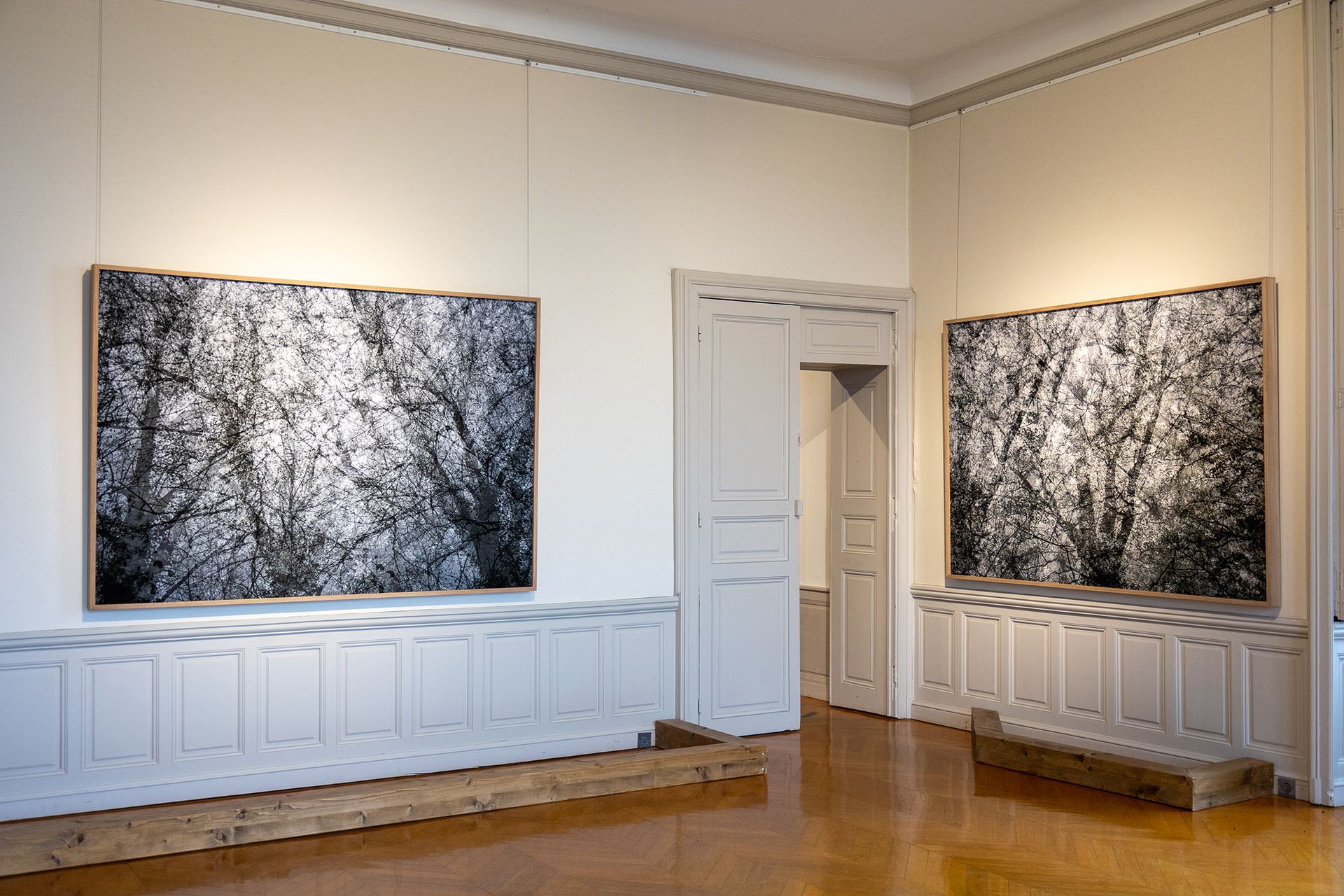
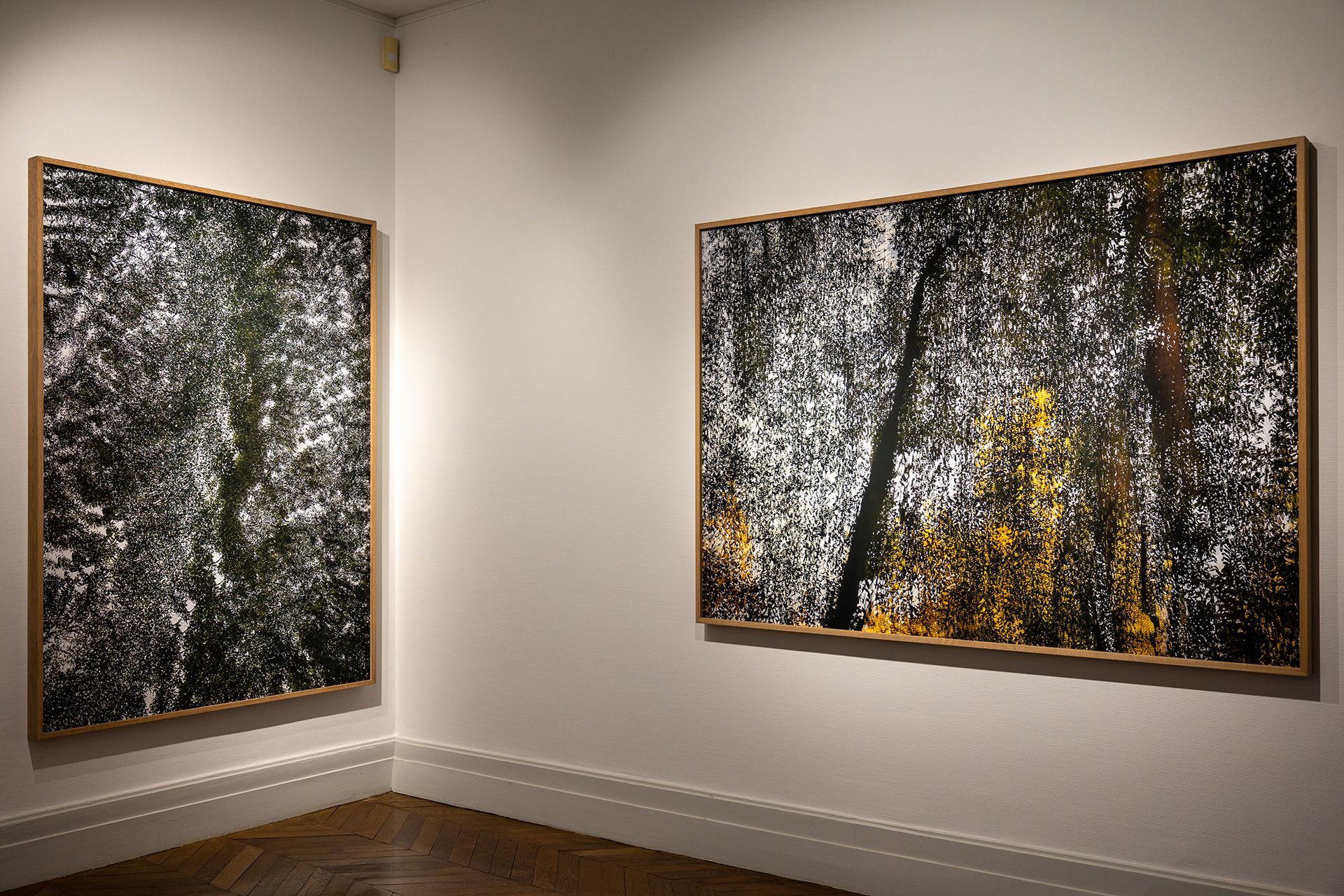
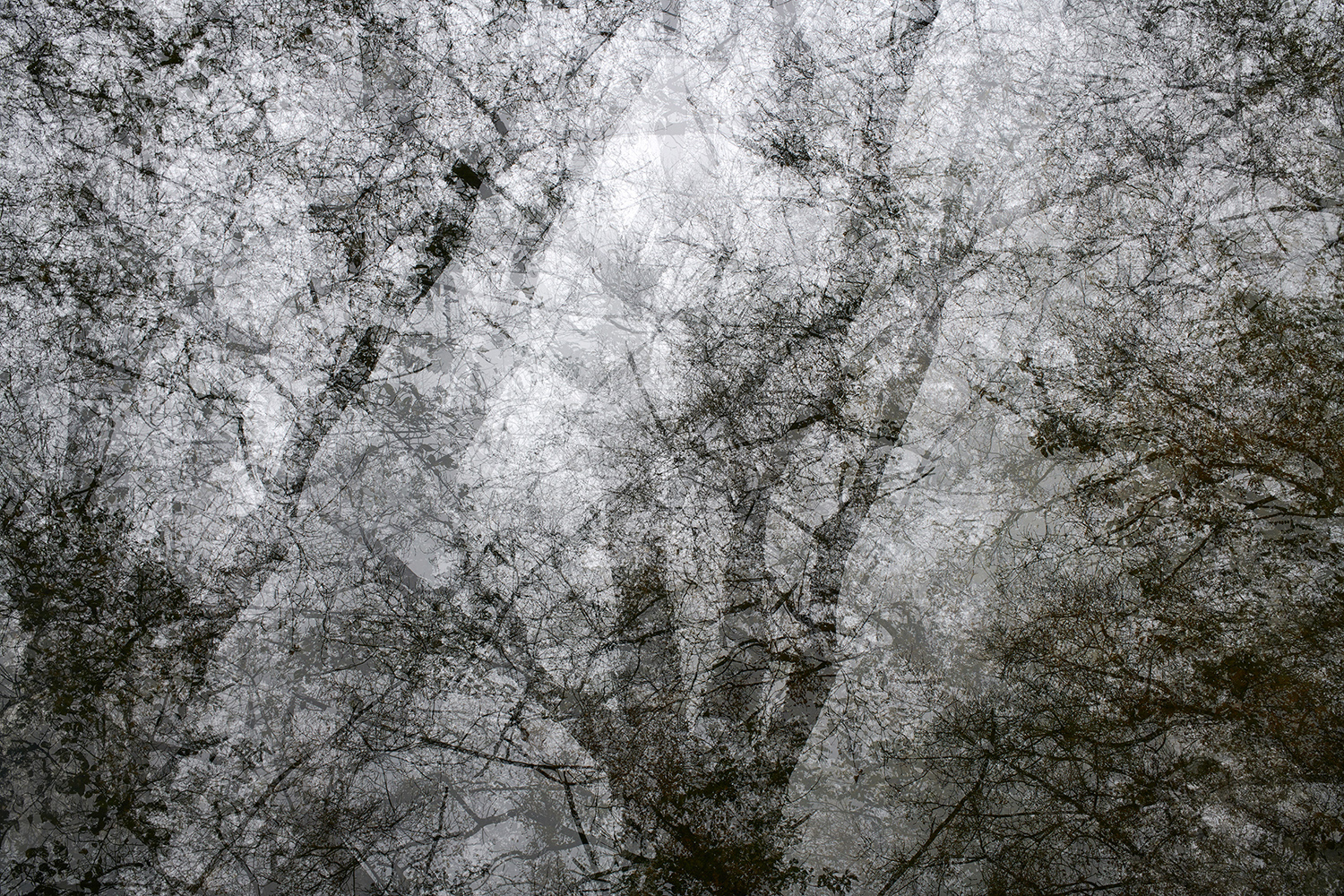
When exploring Éric Bourret’s work, the eye may be led to wonder what exactly it is looking at. Is it really photography? Might it not rather be drawing, engraving or painting? Such uncertainty fascinates, calling up as many artistic references as there are imaginations. The photographer himself readily refers to Simon Hantaï and Gerhardt Richter and, as far as photography is concerned, Gustave Le Gray. Although Éric Bourret’s body of work fits so well into the history of art, this does not mean that it ignores the contemporary world’s concerns and the repeated blows suffered by the planet. “By rejecting all horizons and staying as close as possible to the manifestation itself, the photos he took on the banks of Lake Sagalou confirm in this respect that all surfaces, whether those of our planet or those on which our biographical plans are set in motion, are above all theatres of illusion where, at the end of the day, categories of near and far, ancient and modern, where the visual aspects of mountaintops, plains and abysses are no more than ephemeral, fleeting extras in our human intrigues”, the writer Pierre Parlant suggests.
BIOGRAPHICAL NOTES

Born in Paris in 1964, Éric Bourret lives and works in France as well as in some of the world’s most remote regions, from the Himalayan peaks to Iceland’s fjords, China’s primary forests and the islands of Macaronesia. His work as an artist-walker follows in the footsteps of English land artists and wandering landscape photographers. Since the early 1990s, he has been travelling the world on foot, taking photographs that he calls “experiences of walking, experiences of the visible”. With these images, Éric Bourret expresses the deep-seated sensorial and physical transformations brought about by walking, which heightens perception.
During his treks, which may last a few days or several months, he applies a protocol decided upon beforehand and which determines the number and spacing of images and then superimposes the various shots of the same landscape on a single negative. These sequences intensify the movement of geological strata and make it visible, doing away with human beings’ ordinary temporalities. This photographic ephemeris upends the initial image’s structure, creating another reality that is both on the move and aware. The image is vibrant, almost alive. More factual series include date, place and distance travelled, so communicating the rhythm and space of his walker’s log.