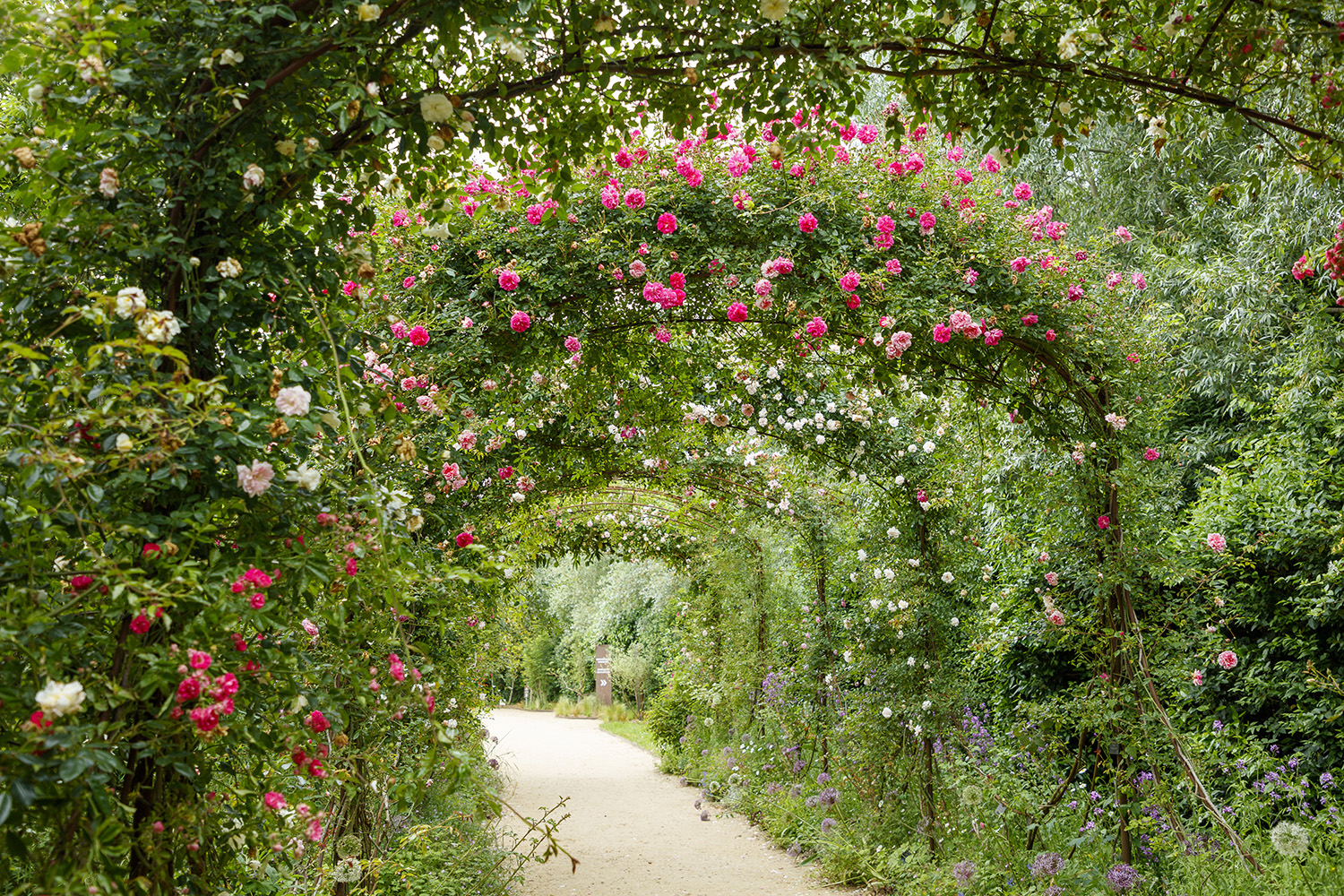
The garden
The Domain of Chaumont-sur-Loire decided to showcase the horticultural heritage of the Centre-Loire Valley region by displaying a collection of climbing and rambler roses from Orléans.
Rosa wichuraiana
are often admired for their magnificent flowers and add a touch of elegance and opulence when used to decorate the arches, gazebos and pergolas in our gardens.
The rose Rosa wichurana Crép. is a vigorous shrub with supple, trailing or climbing stems, native to Japan, Korea and eastern China. At the turn of the 20th century, the Fauque, Turbat and Barbier families of Orléans deepened their research into the hybridisation of this species and created numerous varieties of climbing roses. Hybrids of Rosa wichurana, thanks to their sumptuous flowering, are still prized for decorating the arches, arbours and pergolas of our gardens with elegance and opulence.
CLIMBING ROSES
Albéric Barbier (Barbier, 1900), Albertine (Barbier, 1921), Auguste Roussel (Barbier, 1913 - hybrid of macrophylla), Beauté Orléanaise (Turbat, 1919 - hybrid of wichuraiana), Casimir Moullé (Barbier, 1910 - hybrid of wichuraiana), Élisa Robichon (Barbier, 1902 - hybrid of wichuraiana), Émile Fortépaule (Barbier, 1902 - hybrid of wichuraiana), Francis Fauque (1909 - multiflora), Jean Guichard (Barbier, 1905 - wichuraiana), Joseph Billard (Barbier, 1906 - hybrid of wichuraiana), Jules Levacher (Barbier, 1906 - wichuraiana), Léontine Gervais (Barbier, 1905 - hybrid of wichuraiana), Marie Gouchault (Turbat, 1927 - Hybrid Tea), Madame Charles Detraux (Vigneron, 1895 - Hybrid Tea), Paul Transon (Barbier, 1900 - hybrid of wichuraiana), Printemps Fleuri (Turbat, 1922 - hybrid of multiflora), René André (Barbier, 1901 - wichuraiana), Triomphe Orléanais (Turbat, 1922 - polyantha climbing), Wichmoss (Barbier, 1911 - wichuraiana).
RAMBLING ROSES
Alexandre Girault (Barbier, 1909 - hybrid of wichuraiana), Alexandre Tremouillet (Barbier, 1902 - hybrid of wichuraiana), Auguste Gervaise (Barbier, 1918 - hybrid of wichuraiana), Fraîcheur (Turbat, 1921), Neige d’Avril (Robichon Altin, 1908).