ARTISTIC APPROACH
Sam Szafran is an altogether atypical artist, a painter completely without ties, unclassifiable, extraordinary, outside any discernible movement. Possessed of rare sensibility and culture, he has succeeded in converting the many sufferings of a difficult life into a body of work of unique power and virtuosity.
He has produced close to 2,000 works, comprising 800 watercolours and 1,200 pastels of incredible chromatic richness, created with phenomenal dexterity by an artist who has stated that he has “enough to keep me drawing for 400 years”.
“His drawings are pretexts for a perfectly mastered abstract playfulness that animates the inanimate and gives the power of life to the inert”. Jean Clair
Three major themes run through his work in almost obsessive fashion: studio interiors, staircases and plants.
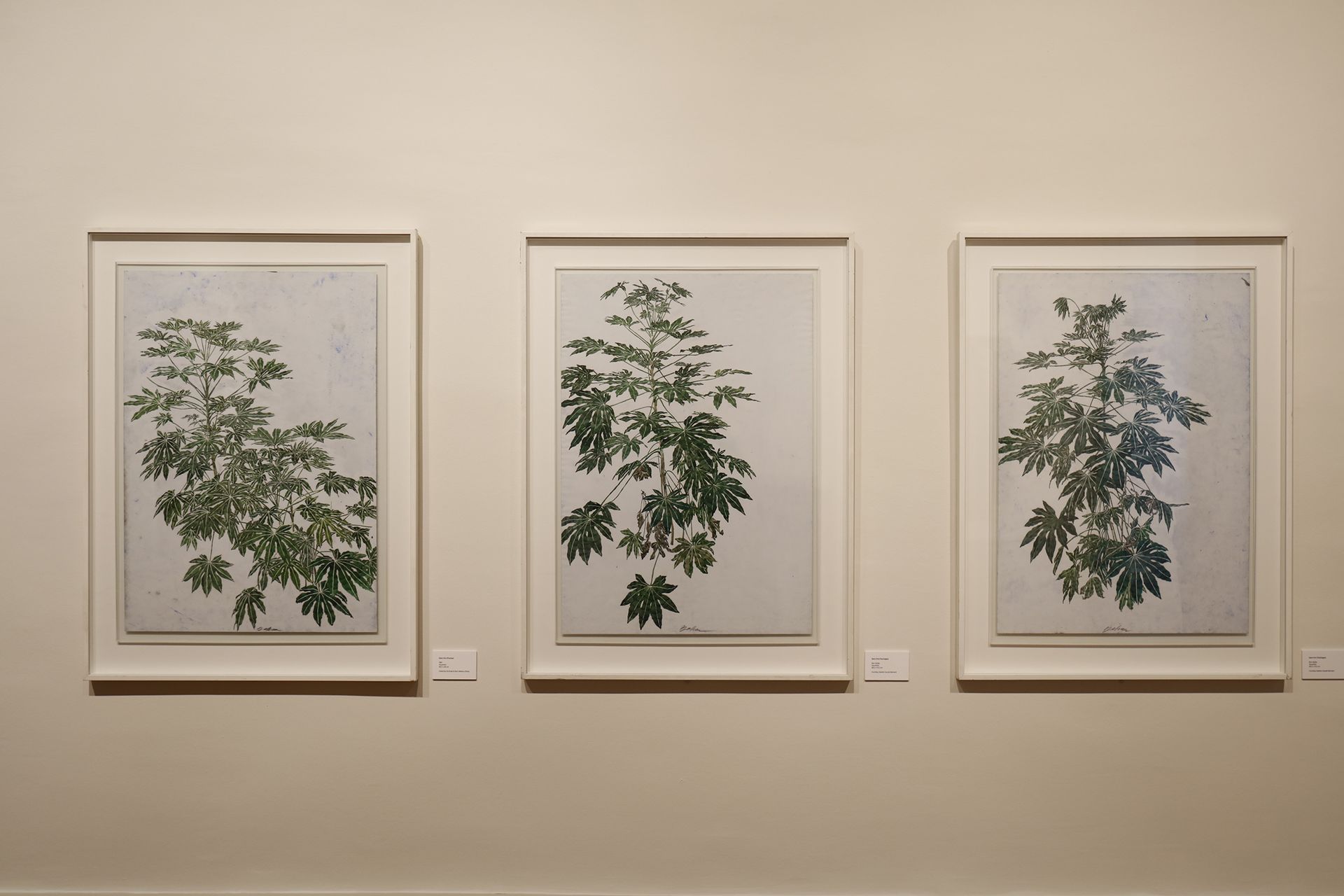
It is obviously his phantasmagorical foliages and arborescences that will be on display at Chaumont-sur-Loire, in an exhibition bringing together many of the artist’s masterpieces on loan from private collections.
With his inextricable jungles of philodendrons and hallucinatory cascades of finely worked Monstera leaves, Sam Szafran reinvents nature, concentrating it into extraordinary hanging gardens. The mysterious and vertiginous luxuriance of these inner landscapes harbours incredible poetic power.
"There’s always a sense of imbalance in what I do.”
"My perspective is closer to the Arab perspective, based on the eye’s oval shape rather than traditional geometric perspective, which is characterised by a horizon line and vanishing points”.
"Something else results from it, another ambience, another system, another way of seeing. An invention started over and over again.”
"I need chaos; my studio is chaotic, between layers of books, pastels lying around everywhere and piles of this, that and the other. In order to produce something, I need to start out from chaos”. Sam Szafran
BIOGRAPHICAL NOTES
Sam SZAFRAN
FRANCE

1934 Born is Paris on 19 November, the eldest son of Polish Jewish immigrants. He spends his early childhood in Paris’ Les Halles district.
1940–1944
During the war, Sam Szafran escapes the Vel d’Hiv Roundup, hiding out first of all at a farmhouse in Loiret. Imprisoned in Drancy, he is freed by the Americans and goes into hiding in Lot, taken in by some Spanish Republicans. 1944
Sent by the Red Cross to Winterthur in Switzerland, while his father and most of his family die in Nazi camps. 1947
Leaves for Australia with his mother and sister to join his uncle in Melbourne.
1951 Back in France, he takes drawing classes in Paris and leads a particular hard and uncertain artist’s life.
1953 – 1958
Académie de la Grande Chaumière, in Henri Goetz’s studio; makes the acquaintance of Jean Ipousteguy, Orlando Pelayo, Jacques Delahaye, Nicolas de Staël, Jean-Paul Riopelle, Joan Mitchell, Yves Klein, Jean Tinguely and many others; a series of makeshift studios.
Discovery of Kurt Schwitters’ collages, Dubuffet’s “Matériologies et Texturologies”, Hantaï and Réquichot.
1958–1965
“Choux” Period (during which he painted cabbages). The gift of a box of pastels marks a major turning-point in his work; from now on pastels become his preferred tools of trade. 1961
Decisive encounter with Alberto Giacometti. 1963
Marries Lilette Keller. 1964
Birth of their son Sébastien; Szafran joins the Claude Bernard Gallery. 1965
Meeting with Jacques Kerchache, who organises the artist’s first one-man exhibition. 1969–1970
“Ateliers” Period. 1970
“Fusains”, exhibition at the Claude Bernard Gallery, Paris. 1972
“Pastels”, exhibition at the Claude Bernard Gallery, Paris. “Imprimeries” Period. Joins Fernando Arrabal, Roland Topor and the Panic Movement for a short time. 1974
Moves to Malakoff, where he still lives. First Staircases. Exhibition at the Artel Gallery, Geneva. 1977-1978
1977-1978
First watercolours, which he goes on to develop around the themes of Studio interiors, Greenhouses and Staircases.
“Pastels”, exhibition at the Claude Bernard Gallery, Paris. 1987
“Aquarelles”, exhibition at the Claude Bernard Gallery, Paris.
Circa 1987, Starts combining pastel with watercolour, dry with wet, focusing on the themes of greenhouses, staircases and towns. 1988–1989
One-man exhibition at Caja Iberia, Saragossa. 1992
One-man exhibition at the Vallois Gallery, Paris. 1999–2000
“Fifty Years of Painting”, retrospective at the Pierre Gianadda Foundation in Martigny, Switzerland. First large-scale Urban Landscapes. 2000–2001
Retrospective at the Musée de la Vie Romantique, Paris. 2004 – 2005
Works with ceramist Juan Gardy Artigas for the “Pavillon Szafran”; “Le Pavillon Szafran” exhibition at the Gianadda Foundation, Martigny. 2008
2008
Exhibition at the Hopkins-Custot Gallery, Pavillon des Arts et du Design, Tuileries Garden, Paris.
Retrospective at the Max Ernst Museum in Brühl, near Cologne, Germany.
2013
Retrospective at the Gianadda Foundation, Martigny, where he exhibits his very large format works for the first time.
Sam Szafran is represented by the Claude Bernard Gallery.