ARTISTIC APPROACH
Naoya Hatakeyama's photography presents a meticulous, ongoing investigation into the conflictual relationship between people and nature.
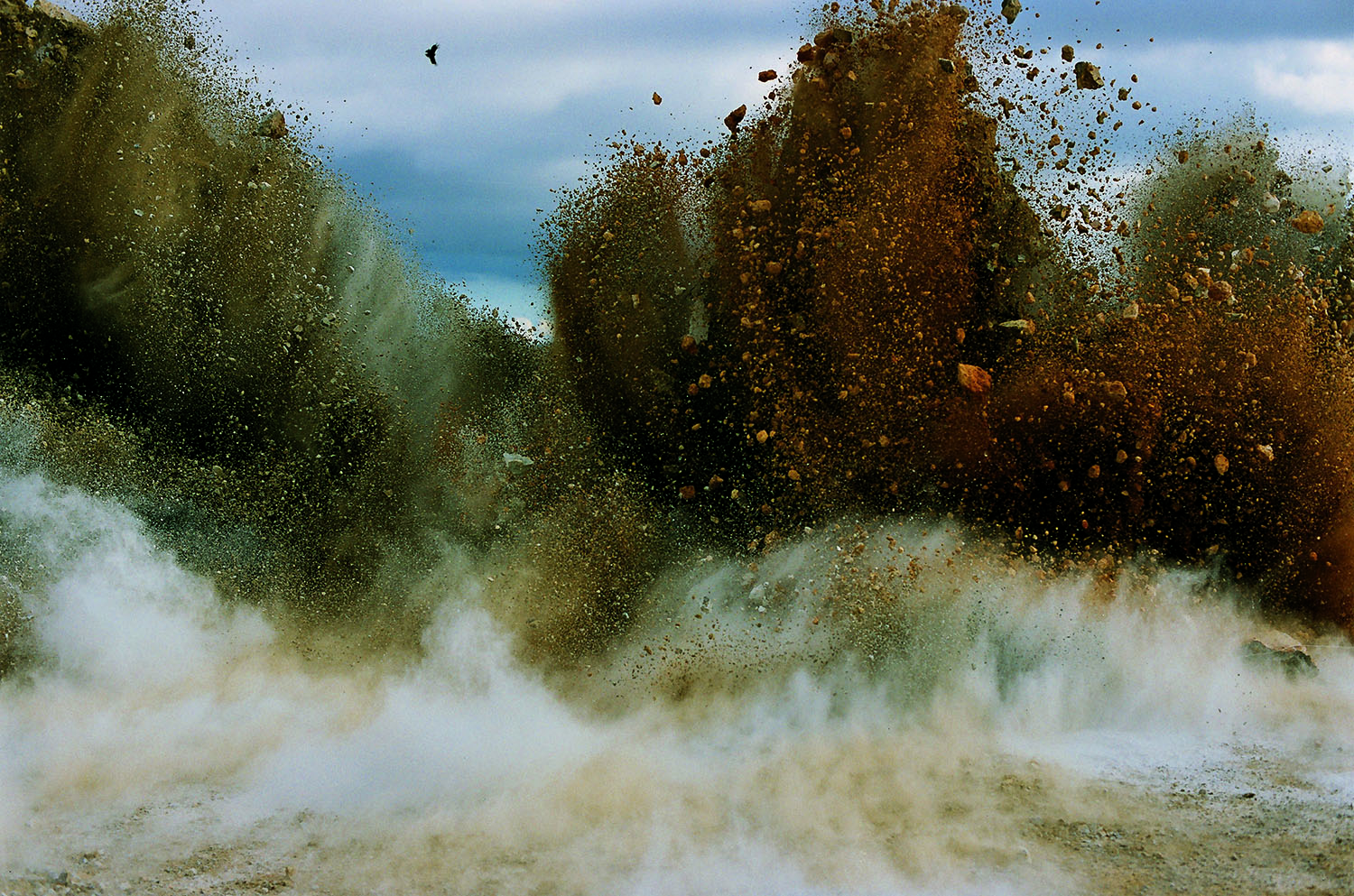
Embracing a wide range of themes, he devoted his first series to limestone quarries (Lime Hills, Japon, 1986-1991). In Underground (1999), he explored the urban and underground rivers of Tokyo. He returned to his first subject of choice some ten years later by photographing the limestone quarries beneath the streets of Paris (Ciel Tombé, 2007)… Next up was Blast, a series of images that Hatakeyama began in 1995, in a thought-provoking report on explosions in open quarries … Deeply moved by industrial transformations, he was invited to photograph the coal mines and industrial wastelands in the Rhineland in the winter of 2003 and presents us with powerful images of the Westphalia coalmine (Zeche Westfalen I/II Ahlen, 2003-2004). Showing abandoned industrial structures and blown-up factories, his large-format colour photographs accompany and transcend the landscape. In 2009-2010, he photographed the slag heaps, artificial hills piled with mining waste, in the mining area of Nord Pas-de-Calais.
In 2011, Naoya Hatakeyama created his most personal work to date. After the earthquake and tsunami that struck the Pacific coast off the Tohoku region in Japan, on 11 March 2011, he flew to the town of Rikuzentakata where he was born to photograph what remained in the wake of its devastation. Kensegawa, his book that was published in 2013, paints a portrait of this ravaged region. Alongside poignant images capturing the chaos, he presents shots taken several years earlier, between 2002 and 2010, when the town was bustling with life ... For Naoya Hatakeyama, photos are a memory-preserving medium. They collect together the very last traces of a past forever behind us.
The series on display in Chaumont-sur-Loire convey the magic of the dangerous game we play with nature - forgetting the tragic consequences of our repeatedly destructive measures. Through fascinating images of an altogether serious beauty, Hatakeyama catches our eye with scenes to which we would not have given time of day, but which immediately spark environmental awareness within us.
BIOGRAPHICAL NOTES

Naoya Hatakeyama at the Domaine de Chaumont-sur-Loire, 2015 -© Éric Sander
Naoya Hatakeyama is considered to be one of Japan's leading contemporary photographers. Born in 1958 in Rikuzentakata, Iwate Prefecture, Japan, he lives and works in Tokyo. A student of Kiyoji Otsuji, he graduated from the Art and Design School of Tsukuba University (1981-1984).
He has taken part in a whole host of personal and collective exhibitions. In 2001, he represented Japan at the 49th Venice Biennale (with Fast and slow. Curated by: Eriko Osaka). The Tokyo Metropolitan Museum of Photography devoted a personal exhibition to him in 2011, Naoya Hatakeyama: Natural Stories, for which 100 photographs and two video installations were brought together for the public. The exhibition would then be put on display at the Huis Marseille Museum in Amsterdam (2011) and San Francisco Museum of Modern Art (SFMOMA, 2012).
At the 13th Venice Biennale of Architecture (2012), along with Toyo Ito he took part in the exhibition Architecture. Possible here? Home-for-All, a project addressing the reconstruction of Rikuzentaka in the wake of the 2011 tsunami. The Japanese pavilion won the Golden Lion for best national participation.
He is represented by Taka Ishii Gallery (Tokyo).