ARTISTIC APPROACH
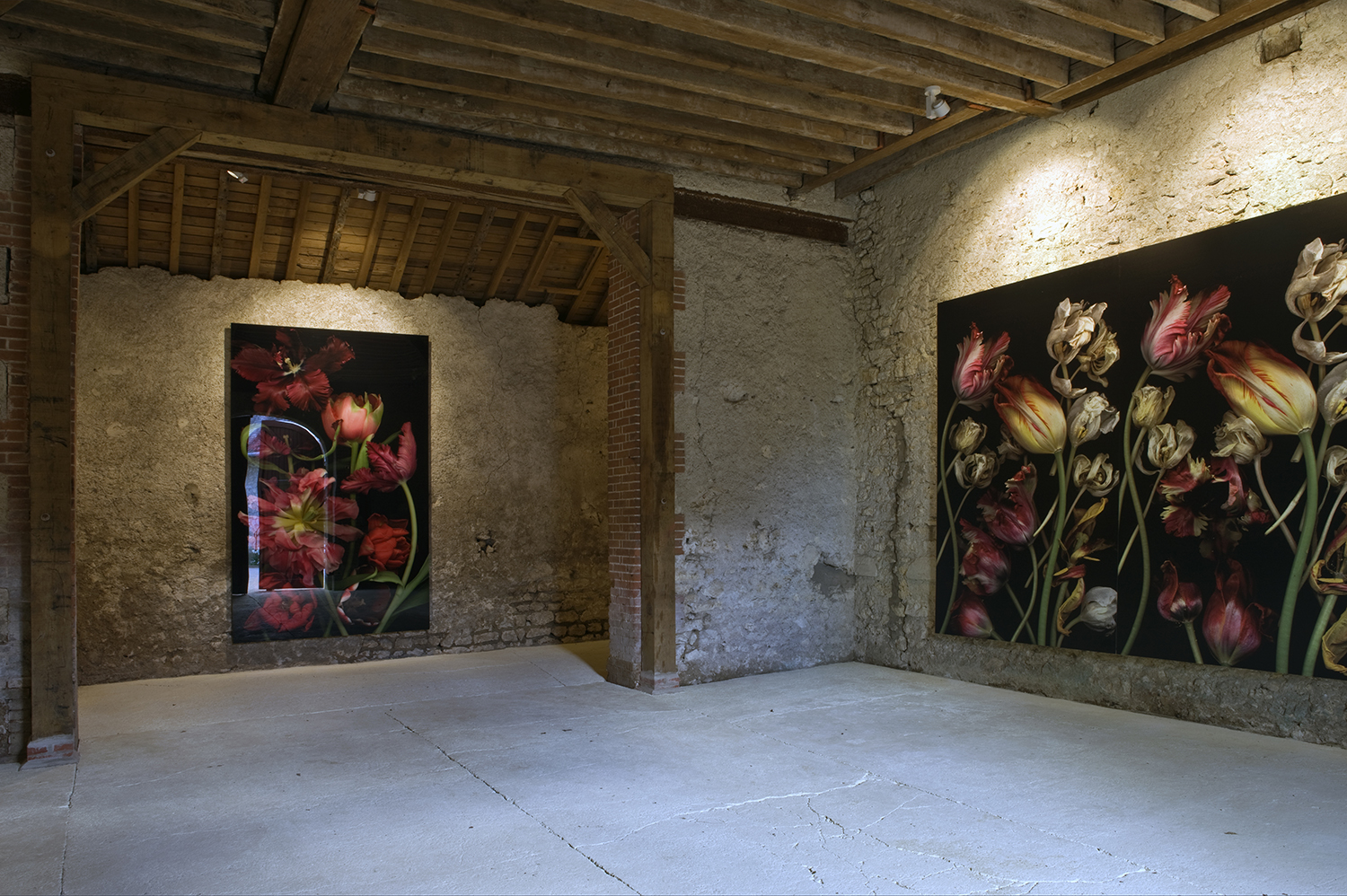
Luzia Simons also offers a journey into colour through a series of large-format scanograms of depixelated and repixelated tulips. This is not a matter of scanning reproductions of tulips, but truly of scanning the flowers themselves.
The motifs are fragmented, ultra-precise in detail and enlarged to an inconceivable degree.
The camera is modelled on the human eye. Its construction obeys the natural laws of optics with their physical mechanisms: convex lens, focused light rays, accommodation to the distance of the object. It has an individual point of view, fitted with a light-sensitive receiving surface that creates a virtual image of reality. The missing dimension of depth is compensated for by the theorem of perspective.
The scanner, unlike the camera, has no point of view. The former observation post, once fixed, has been set in motion and turned into a way of seeing. The scanner has neither lens nor focal point, and knows neither perspective nor vanishing line. Like a blind person, it apprehends reality by feeling its way, storing the pixels of the image side by side with the greatest precision and regularity. Everything in the foreground is clear and sharp to it, while depth of field dissolves into a blurred darkness. It is as if the scanner were the technique suited to a globalisation in full swing.
It is no coincidence that Luzia Simons scans tulips. The tulip and its bulb, once as precious as gold, originating not from Holland but from Iran and Turkey, where they still symbolise the life of a loved one today, hold a particular artistic interest for Luzia Simons. Cultural confusion and loss of identity, but also, in return, enrichment through exchange, are the subjects the artist has long explored, in works such as Transit, Face Migration, Luftwurzeln .
The Baroque reference to the beauty and transience of things is above all ironic. These tulips, on the other hand, resolutely put themselves on show and become the actors of a great chromatic drama. Yet they are not individuals. The artificiality of the scanned surface, this perfectly flat image of micrographic precision, reflects the boundary between image and reality like a sensitive skin.
Luzia Simons also offer a trip into colour through a series of large scannograms of depixellated and repixellated tulips. This involves scanning the flowers themselves as opposed to scanning reproductions of tulips.
BIOGRAPHICAL NOTES