Přejít na obsah
Chaumont-Photo-sur-Loire 2022/2023

Éric Bourret

"Arbos" and "Primary forest"
Le Château

Artistic approach

“I am composed of the landscapes that I cross and which cross me. For me, the photographic image is a receptacle for forms, energy and meaning.”

A photographer with a career going back 30 years, Éric Bourret spends his life roaming “natural” regions in order to report on the movement that brings them to life. His long walks and the unique photographic records he brings back result in series that all have connections with the landscape’s memory. “The memory of places is more alive than that of the entombed mortals who erected them to their own glory at the price of the sweat and blood of slaves weighed down by blocks of stone and breaking their backs piling up dressed rocks – pyramidal Meccano or labyrinthine maze where the echoes of the higher voices captured by the photographer’s hieratic lens wander and lose their way”, writes the photography critic Patrick Roegiers, referring to a walk undertaken in the land of the pharaohs.

Viewed as the photographic notes of a score encompassing whole landscapes, Éric Bourret’s images bear witness to subjective experience. The artist-walker spends more than 6 months a year travelling, not only in France, Provence and Pays de Loire, but also in China and South Africa’s primary forests. “Whether you’re in the Himalayas or the High Alps, walking is an invitation to austerity. It can also be a philosophical act and a spiritual experience. […] The photographic machine records the experience of the landscape crossed and makes it visible. The photograph transcribes the flows that bring the landscape to life, like those that bring our own bodies to life. […] Physiologically, walking for eight hours a day gives rise to a whole new attitude to space and keeps you in excellent condition. So much so that, in the end, I don’t really know if I’m seeing with my eyes or with my body”, Éric Bourret explains, on the occasion of the exhibition currently underway at the Lodève Museum in Hérault.

During these walks, the artist takes numerous photographs following very specific protocols. He seeks to capture the constant flow that invigorates the landscape, the vibrations of an energy in the very heart of the land, and then strives to dispossess himself of the result. Each image must reveal and escape, causing a sensation of light-headedness, which the photographer sees as a sign that “it touches upon reality”, as the sociologist Gilbert Beaugé explains, going on to say that “For an image that is sufficient unto itself, Éric Bourret speaks of ‘culmination, ‘strength’, ‘implacability’, ‘a life of its own’, and above all of exceedance is-à-vis himself.”

Hence, the photographer loses himself in very personal contemplation of the landscape without every trying to document it. He seeks to explore the poetic and extremely powerful overflowing of energies that he discovers in the heart of nature. “You might say that the photographer looks at the landscape like a land artist, but without direct intervention and without appropriation. He doesn’t touch it; inside, he seeks the benchmarks of its progress. He wanders like the falling snow. He lets himself be touched by a tangible array of forms and materials, with acute perception of the spaces within space. He is right inside, anticipating the possibilities provided by the experience of the walk and the visible”, the writer and art critic Sophie Braganti emphasises. This meditative poetry draws on the explorations of land art, minimal art and performance art. Celebrating the way in which the landscape’s components interlock with each other, the artist seeks to reveal nature as a creative power like art, whether the eye focuses on the microcosm or the macrocosm. “Éric Bourret’s most graphic works fall within that broad anti-materialist, anti-nominative and anti-individualist tradition of depicting the world where the artist no longer sees himself as a creator but rather as a medium, a purveyor and, more prosaically here, as a walker recording the world’s reality on his photographic screen”, the curator Jean-Rémi Touzet suggests.

When exploring Éric Bourret’s work, the eye may be led to wonder what exactly it is looking at. Is it really photography? Might it not rather be drawing, engraving or painting? Such uncertainty fascinates, calling up as many artistic references as there are imaginations. The photographer himself readily refers to Simon Hantaï and Gerhardt Richter and, as far as photography is concerned, Gustave Le Gray. Although Éric Bourret’s body of work fits so well into the history of art, this does not mean that it ignores the contemporary world’s concerns and the repeated blows suffered by the planet. “By rejecting all horizons and staying as close as possible to the manifestation itself, the photos he took on the banks of Lake Sagalou confirm in this respect that all surfaces, whether those of our planet or those on which our biographical plans are set in motion, are above all theatres of illusion where, at the end of the day, categories of near and far, ancient and modern, where the visual aspects of mountaintops, plains and abysses are no more than ephemeral, fleeting extras in our human intrigues”, the writer Pierre Parlant suggests.

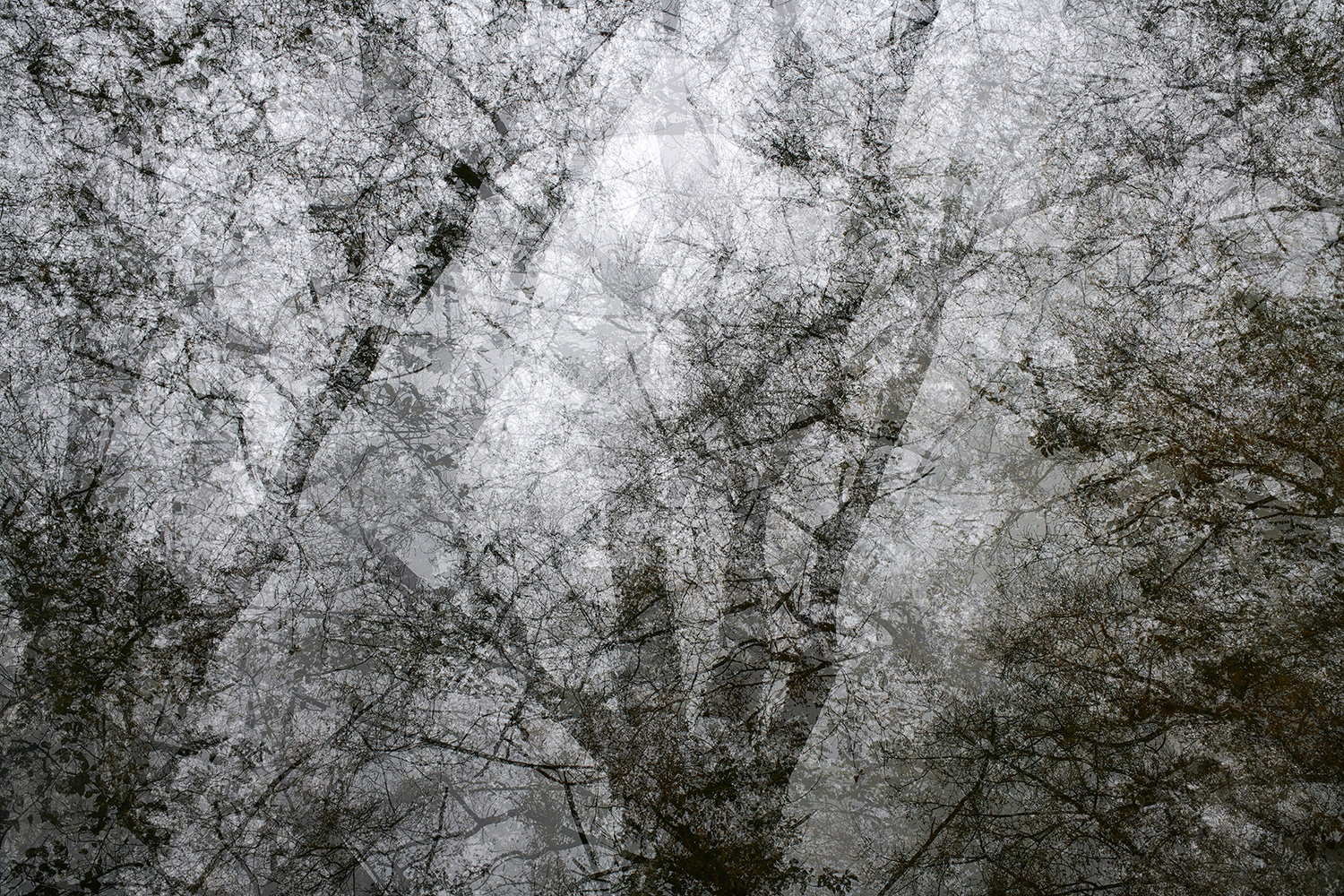
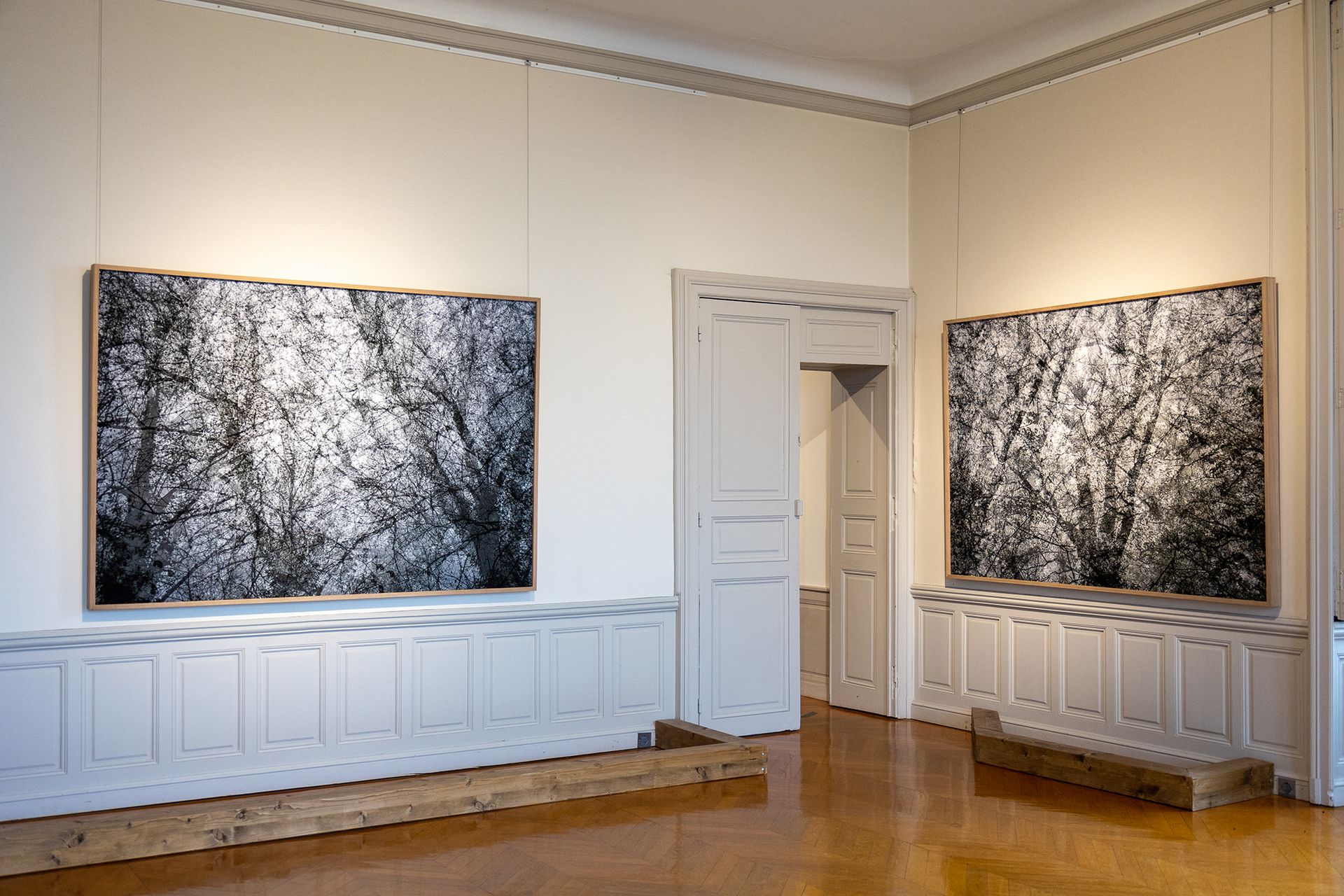
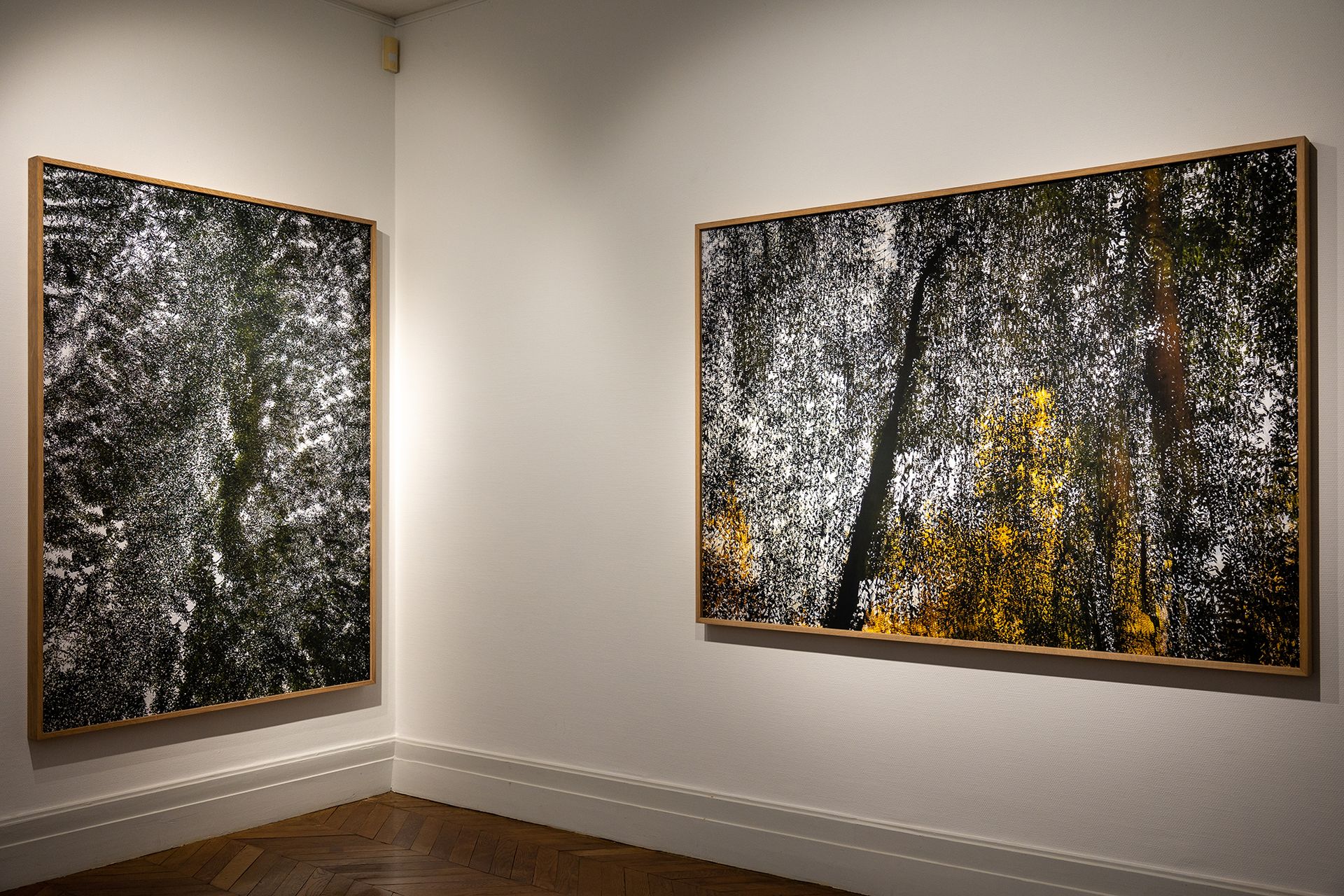
Éric Bourret will be hanging a series of previously unseen photographs on Chaumont-Photo-sur-Loire’s picture rails, taken in the lands through which the Loire flows and entitled Arbos. Most of the quotations in this text are extracts from the book Éric Bourret - Écrit d’auteurs 1997-2021, recently published by ARTGO & Cie. The series is the result of the walks he took along the pathways bordering the Loire during the winters of 2021 and 2022.
He will also be presenting a dozen prints from the Primary Forest series, photos taken during the time he spent roaming the Macaronesian islands’ (Azores, Madeira and the Canaries), China’s and Finland’s primary forests between 2016 and 2019.

BIOGRAPHICAL NOTES

Éric BOURRET
FRANCE


Born in Paris in 1964, Éric Bourret lives and works in France as well as in some of the world’s most remote regions, from the Himalayan peaks to Iceland’s fjords, China’s primary forests and the islands of Macaronesia. His work as an artist-walker follows in the footsteps of English land artists and wandering landscape photographers. Since the early 1990s, he has been travelling the world on foot, taking photographs that he calls “experiences of walking, experiences of the visible”. With these images, Éric Bourret expresses the deep-seated sensorial and physical transformations brought about by walking, which heightens perception.

During his treks, which may last a few days or several months, he applies a protocol decided upon beforehand and which determines the number and spacing of images and then superimposes the various shots of the same landscape on a single negative. These sequences intensify the movement of geological strata and make it visible, doing away with human beings’ ordinary temporalities. This photographic ephemeris upends the initial image’s structure, creating another reality that is both on the move and aware. The image is vibrant, almost alive. More factual series include date, place and distance travelled, so communicating the rhythm and space of his walker’s log.
LES ARTISTES

PUBLIC COLLECTIONS

Artothèques de Draguignan, Miramas, Grenoble, Nantes and Nice, France
Bibliothèque Nationale de France, Paris, France
Fondazione Italiana per la Fotografia, Torino, Italy
Fonds Départemental, Conseil général de l’Yonne, France
Galerie du Château d’Eau, Toulouse, France
Hôtel des Arts, Centre Méditerranéen d’Art, Toulon, France
Le Centre d’Art Informel de Recherche sur la Nature, Digne-les-Bains, France
Le Parvis, Tarbes, France
Maison Européenne de la Photographie, Paris, France
Musée d’Art Contemporain et d’Art Moderne, Nice, France
Musée d’Art Contemporain, Marseille, France
Musée d’Art et d’Archéologie, Aurillac, France
Musée de l’Élysée, Lausanne, Switzerland
Musée Gassendi, Digne-les-Bains, France
Musée Géo-Charles, Échirolles, France
Musée Granet, Aix-en-Provence, France
Musée Muséum départemental des Hautes-Alpes, Gap, France
Musée Picasso, Antibes, France
Musée Ziem, Martigues, France
Muséu da Imagen, Braga, Portugal
Museum of Contemporary Art of Tamaulipas, Mexico
Portfolio Hermès remis aux Chefs d’États, Conseil Européen, Nice, France
The Photographic Museum of Finland, Helsinki, Finland
Théâtre de la Photographie, Nice, France
Xie Zilong Photography Museum, Changsha, China

MONOGRAPHIC EXHIBITIONS (SELECTION)

2021
Flux, Centre de la Vieille Charité, Festival Photo Marseille & Musées de Marseille, France
Sainte-Victoire – 1991-2021, Musée du Pavillon de Vendôme, Aix-en-Provence, France
2019
Éric Bourret walks alone, Sapar Contemporary Gallery, New-York, USA
Walk, Xie Zilong Photography Museum / XPM, Changsha, China
2018
Zéro, l’infini, Espace à Vendre, Nice, France
The 3rd Shenzhen International Photography Week, Shenzhen Art Museum, China
Impression, Éco-Musée, Volx, France
2017
Carnet de marche, Musée Dauphinois, Grenoble, France
2015
Et l’espace fera de moi un être humain, Musée Ziem, Martigues, France
Le temps de la marche, Abbaye de Montmajour, Arles, France
Timescape, Galerie Esther Woerdehoff, Paris, France
2014
Le temps de la marche, Galerie Jean Greset, Besançon, France
2013
Timescape, Galerie Lazarew, Paris, France
2012
Excuse me, While I Kiss the Sky, Centre d’Art Le Moulin, La Valette-du-Var, France
2010
Hun-Tun, Musée d’Art Moderne et d’Art Contemporain, Nice, France
What do we really know about landscape?, Arts on Main, Johannesburg, South Africa
Lure, Musée Prieuré de Salagon, Mane, France
2006
Le Var et l’ailleurs, Hôtel des Arts, Toulon, France
2004
Montagne au Carré, Musée Muséum, Gap, France

GROUP EXHIBITIONS (SELECTION)

2019
Par Hasard, Friche la Belle de Mai, Centre de la Vieille Charité, Marseille, France
Bis Repetita Placent, Espace de l’Art Concret, projet des marches, démarches FRAC PACA, Mouans-Sartoux, France
Fresh Winds Art Biennale 6, Gardur, Sandgerdi, Iceland
Dans la gueule de l’espace, Galerie Martagon, projet des marches, démarches FRAC PACA, Malaucène, France
2018
Nouvelles acquisitions, Arthothèque, Miramas, France
Tous à la plage!, Fermé le lundi, Marseille, France
Nuits Photographiques de Pierrevert, Golf du Lubéron, Pierrevert, France
2017
Horizons, Abbaye de La Celle, France
Quartet, Galerie du Canon, Toulon, France
2016
Hazard, Hazard Gallery, Johannesburg, South Africa
Start, Saatchi Gallery, London, Great Britain
Photomed, Maison du Patrimoine, La Cadière d’Azur, France
2015
Crossing Borders, 56° Biennale d’Art de Venise, Palazzo Mora, Italy
Borders, Museum of Contemporary Art of Tamaulipas, Mexico
Nuit(s), Musée de la Photographie André Villers, Mougins, France
2013
Et si ce n’était pas la mélancolie, Musée Géo-Charles, Échirolles, France
Paysages, Château de Tanlay, France
Mer & ciel, Musée d’Art, Toulon, France
2011
Élévations, Galerie DNR, L’Isle-sur-la-Sorgues, France
Parcours photographiques, Théâtre de la Photographie et de l’Image, Nice, France
Regard sur la collection, Hôtel des Arts, Toulon, France
2010
BNF, acquisitions récentes, Musée départemental Arles Antique, RIP Arles, France

WALKS RELATING TO PROJECTS (SELECTION)

2021
Marche hivernale dans la fôret primaire, Madère, Portugal
Marche hivernale dans les massifs de la Sainte-Baume et Sainte-Victoire
Traversée estivale des Alpes
2020
Marche hivernale. Fresh Winds Biennale Festival, Islande
Marche hivernale au Cap-Vert
Marche d’hivers et printemps dans les massifs des Écrins, Oisans et Dévoluy
Marche estivale en Savoie
2019 – 2015
Marche hivernale dans les forêts primaires. Iles de Tenerife, la Gomera et Madère, Espagne, Portugal
Marche automnale dans les forêts primaires, iles de Madère et Açores, Portugal
Marche hivernale sur le territoire du Cradle of Humankind, Afrique du Sud
Marche hivernale dans la Death Valley et Mojave Desert, USA
Marche hivernale dans les îles de Malte et Gozo, Malte
Marche hivernale au Svalbard, Norvège
Marche hivernale au Groenland
Marche hivernale en Islande
Marche d’hivers, printemps dans les Alpes du Sud
Marche hivernale dans les Massifs du Vercors, Oisans et Belledonne
Marche hivernale sur le territoire des Causses du Larzac, Méjean, Noir
Marche hivernale dans les massifs du Mercantour et des Écrins
Marche estivale dans les Alpes du Nord
Traversée de printemps sur l’océan Atlantique
Traversée estivale sur la mer Égée
2014 – 2004
Marche de printemps et d’été au Ladakh, Changtang, Zanskar et Paldar, Inde
Marche hivernale dans les massifs du Khumbu, Annapurna et Mustang, Népal
Marche estivale sur les hauts plateaux du Rupshu et Changtang, Tibet et Inde
Marche hivernale sur le territoire du Cradle of Humankind, Afrique du Sud
Marche estivale dans la Sierra Nevada de Mérida, Venezuela
Marche hivernale sur l’Etna, Italie
Marche automnale et hivernale sur la montagne de Lure
Marche automnale et hivernale dans les Alpes du Sud et du Nord
Marche hivernale sur les massifs de la Sainte-Victoire, Sainte-Baume et Alpilles

Sur le web